National Park or Unnatural Disaster?
The Wombat Forest: The Conservation Failure That Threatens Its Future

The legacy of shelterwood forestry, the failure of the VEAC investigation, the suppression of forest growth, the consequences of climate change and the case for a Wombat Climate Forest.
A forest that needed healing, not another declaration of protection
The greatest threat to the Wombat Forest is no longer industrial logging. Commercial native forest harvesting in Victoria ended on 1 January 2024, and the Wombat's future was already being shaped by a far more complicated ecological problem: the legacy of decades of destructive forestry practices that left extensive areas of the forest crowded with tens of thousands of suppressed trees, depleted soils, impoverished understoreys and an increasingly uncertain capacity to survive a hotter, drier climate. The forest's most urgent challenge is not to prevent the cutting of commercially valuable trees. It is to restore the capacity of its damaged regrowth to develop into vigorous, mature forest capable of supporting the biodiversity for which the Wombat is valued.
The Victorian Environmental Assessment Council's Central West Investigation failed to place that challenge at the centre of its recommendations. Instead, the investigation became dominated by the political objective of creating a national park, an outcome promoted by organisations whose approach to forest conservation placed legal reservation above the practical requirements of ecological restoration. The Wombat's long history of disturbance, the condition of its suppressed regrowth, the consequences of climate change and the potential for Traditional Owner-led restoration demanded a more sophisticated response.
The distinction between protecting a forest from exploitation and restoring a forest damaged by exploitation is fundamental. A forest may be protected against further commercial harvesting yet remain structurally impoverished, ecologically vulnerable and unable to develop the habitat required by its wildlife. Legal reservation does not restore depleted soils, release suppressed trees from competition, recreate mature hollows or ensure the survival of vegetation communities under changing climatic conditions.
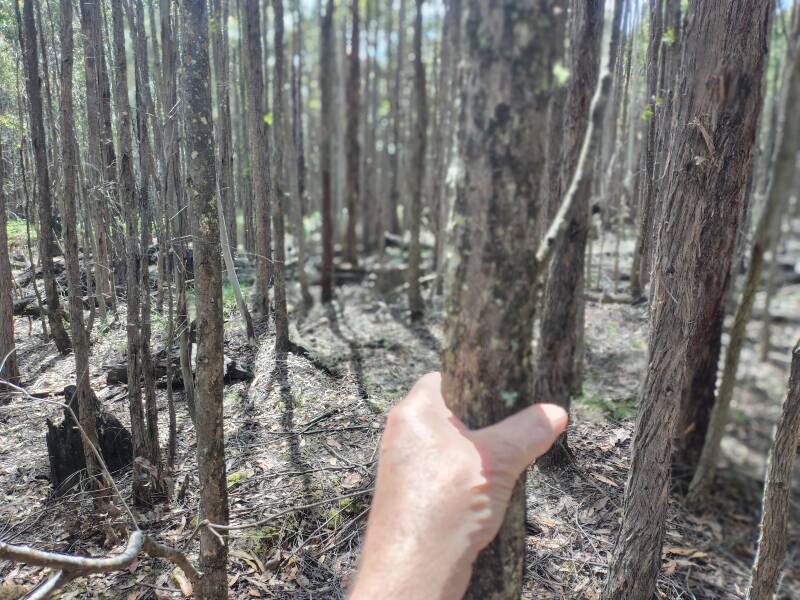
The Wombat's condition demonstrates the danger of treating non-intervention as a universal conservation principle. Across extensive areas, regeneration following shelterwood harvesting and intense regeneration burns produced extraordinarily dense stands of eucalypts. Some contain more than 10,000 stems per hectare, equivalent to more than one tree per square metre. In the most severely suppressed stands, trees 30 to 40 years old remain only three to five metres tall, with trunks approximately 50 to 75 millimetres in diameter. These are not vigorous young forests progressing steadily towards maturity. They are stands in which excessive competition has severely constrained development.
The central question is what happens next. How will a forest containing 10,000 competing stems per hectare develop towards the mature structure once characteristic of the Wombat? Will natural mortality release sufficient growing space for the surviving trees, or will the process take many generations? What happens when drought, heat, fire and declining soil fertility intervene before the forest can recover? And what becomes of the greater gliders, powerful owls, phascogales, possums, wallabies, reptiles and other wildlife that depend on the structural complexity of mature forest?
These questions were not peripheral matters to be considered after the creation of a national park. They were the central conservation questions. A responsible investigation should have begun with the forest's condition, examined the likely trajectory of its recovery and developed a management system capable of addressing the damage. The Wombat Forest Society's alternative was the creation of a Wombat Climate Forest, a new public-land category designed around ecological restoration, biodiversity protection, Traditional Owner management, carbon sequestration and compatible community activities.
That proposal offered an opportunity to turn the legacy of destructive forestry into a programme of practical climate action. Instead of regarding the Wombat's enormous areas of suppressed regrowth merely as land to be reserved, it recognised them as a landscape where relatively inexpensive, carefully planned restoration could improve tree growth, develop future habitat, rebuild ecological resilience and potentially generate measurable carbon benefits.
The failure to give this alternative serious consideration represents one of the most consequential shortcomings of the national park debate.
The original Wombat and the long history of disturbance
The Wombat Forest was not always the dense, relatively uniform landscape found across many of its disturbed areas today. Historical descriptions from the nineteenth century recall stands of large eucalypts separated by substantial growing space, with an understorey that varied according to soils, rainfall, aspect and vegetation type. Accounts of horses and carts travelling freely through parts of the forest convey the openness of particular mature stands. Estimates of approximately 20 to 25 large trees per hectare illustrate the difference between those forests and the extraordinary stem densities produced by later regeneration practices.
The Wombat was never a single, uniform forest type. Its vegetation varied across ridges, slopes, gullies and wetter sheltered areas. The original landscape included complex relationships between trees, shrubs, grasses, herbs, soil organisms, fallen timber and wildlife. Traditional Owner management was part of that ecological history, and the forest's condition was influenced by cultural practices long before European mining and forestry.
The gold rushes of the nineteenth century transformed the region. Timber was cut for mining, construction, fuel and industrial purposes. Extensive disturbance altered the forest's structure, while repeated harvesting and fire influenced subsequent regeneration. The recovery that followed was uneven, and the forest that emerged during the twentieth century was shaped by successive management decisions.
Foresters in the early twentieth century recognised that dense regeneration could suppress growth. Thinning was used to reduce competition and release selected trees, allowing retained stems to increase in diameter and height. The objective was principally to develop a productive forest, but the underlying biological principle remains relevant to ecological restoration: trees competing excessively for limited resources may remain suppressed for decades, while reducing competition can improve the growth of those retained.
Later shelterwood harvesting and associated regeneration practices created a different legacy. Extensive areas were cut and regenerated under conditions that encouraged very high numbers of eucalypt seedlings. Regeneration burns were used to prepare seedbeds and stimulate establishment. The resulting forests often carried far more stems than could develop into large trees within a reasonable timeframe.
The Wombat's present overstocking is therefore not simply an unfortunate natural occurrence. It is a consequence of human decisions about harvesting, burning and regeneration. Those decisions created an ecological responsibility that did not disappear when commercial timber harvesting ended.
The destructive legacy of shelterwood regeneration burns
The damage associated with shelterwood forestry extended beyond the removal of mature trees. Following harvesting, substantial quantities of crowns, branches and other logging debris remained on the forest floor. Regeneration burns were used to prepare the site and promote eucalypt establishment. In heavily stocked debris fields, fuel loads could be very high, with estimates reaching approximately 50 tonnes of logging residue and crown material per hectare in some operations.
Such burns could generate intense heat at the soil surface. The consequences were especially serious in a forest where soils are often shallow and where much of the biologically active material is concentrated near the surface. On some ridges and slopes, the organic-rich topsoil may be only about 50 millimetres deep. Beneath it, the soil profile reflects the underlying geology, with limited depth and nutrient reserves in some locations.
High-intensity fire can consume surface organic matter, kill soil organisms, volatilise nutrients and expose mineral soil to erosion. Nitrogen is particularly vulnerable to loss during combustion, while other nutrients may be redistributed in ash and subsequently lost through runoff or erosion. The consequences depend on fire intensity, duration, soil moisture and site characteristics, but severe burning of a shallow soil profile can impose a substantial ecological cost.
The regeneration burns also created favourable conditions for mass eucalypt germination. Large quantities of seed could establish on the exposed seedbed, producing dense cohorts of seedlings that subsequently competed for the same limited resources. The result was a damaging combination: extraordinarily high numbers of young trees growing on sites whose surface organic matter and nutrient cycles had been disturbed by harvesting and fire.
The problem was therefore not simply that too many trees had germinated. They were attempting to grow in an environment where the available soil resources were limited and, in some places, further depleted by the very operations that encouraged their establishment.
As the seedlings grew, competition intensified. Their crowns increasingly intercepted sunlight, while their roots competed for moisture and nutrients. The ground vegetation that should have contributed to the ecological vegetation class was suppressed beneath the dense eucalypt canopy. Organic inputs from a diverse understorey were reduced, while the development of large trees was delayed.
This history is central to understanding the Wombat's present condition. A forest regenerated at extreme density on shallow, disturbed soils cannot be assumed to follow the same developmental pathway as a naturally established, structurally diverse forest.
The restoration challenge is to reverse the consequences of that history without repeating its destructive practices.
The forest that has stopped growing
The most striking feature of the Wombat's severely overstocked regrowth is the disparity between the age of its trees and their physical development. In the worst affected stands, trees that have occupied a site for 30 to 40 years remain only three to five metres tall. Their trunks may be no more than 50 to 75 millimetres in diameter. Instead of developing into substantial eucalypts, they have remained crowded together in a condition of prolonged growth suppression.
At densities exceeding 10,000 stems per hectare, the forest carries more than one stem per square metre. The competition is not merely between neighbouring crowns. It extends through the soil, where thousands of root systems seek moisture and nutrients from a limited resource base. On shallow soils already affected by earlier disturbance and regeneration burns, this competition is particularly consequential.
The visible condition of the crowns adds to the evidence of suppression. Vigorous developing eucalypts commonly display strong terminal growth, producing a relatively pointed crown. In heavily suppressed stands, the crowns can become rounded, flattened and restricted, reflecting reduced leader growth and limited crown expansion. This is particularly concerning where the trees remain short and slender after several decades.
The forest may look green from a distance, but its appearance at ground level can be profoundly different. In the most crowded areas, little sunlight reaches the soil. The understorey that should contain a diversity of shrubs, herbs, grasses and other non-eucalypt plants is poorly developed or absent. The result is a dense stand of eucalypt poles above a comparatively impoverished ground layer.
This condition represents a serious departure from the structural diversity expected of a healthy forest. A mature ecosystem contains trees of different sizes, canopy gaps, shrubs, ground vegetation, standing deadwood, fallen timber and the habitat features associated with older trees. The Wombat's most suppressed stands are deficient in several of these elements.
The ecological consequences extend beyond the immediate competition among trees. A poorly developed understorey means fewer food and shelter opportunities for many animals. Limited growth of retained eucalypts delays the development of mature habitat. Reduced vegetation diversity can alter nutrient cycling and the distribution of soil moisture. As the forest ages without developing an appropriate structure, the gap between chronological age and ecological maturity becomes increasingly important.
The Wombat therefore faces a form of ecological stagnation. The trees are alive, but the development of the forest has been severely constrained. The challenge is not simply to keep them standing. It is to restore the conditions under which the forest can grow.
The question of centuries: what natural self-thinning really means
Natural self-thinning is often presented as the reason to leave dense regrowth untouched. The argument is that competition will eventually kill weaker trees, allowing the survivors to develop into a mature forest. This process is well established in forest ecology. What is missing from its application to the Wombat is an adequate account of time.
The distinction is crucial. The fact that natural self-thinning occurs does not establish that the Wombat's most severely suppressed stands will recover within 20, 50 or even 100 years. The complete development of a mature forest, including large trees, hollows, complex crowns and a diverse understorey, can take centuries. In stands where growth has already been severely restricted for decades, the recovery process may be slower still.
A forest containing 10,000 stems per hectare must lose 99 per cent of those stems to reach a density of 100 trees per hectare. To approach the more open structure described in some historical accounts, containing 20 to 25 large trees per hectare, more than 99.7 per cent of the original stems must disappear. That transition cannot be achieved simply by waiting for a few suppressed trees to die.
Nor does mortality automatically produce a healthy forest. The outcome depends on which trees survive, whether their crowns and root systems can respond, the condition of the soil, the availability of moisture and the effects of subsequent disturbance.
Under prolonged competition, a stand may develop a limited number of surviving dominant trees surrounded by numerous dead standing stems and persistently suppressed individuals. The result may be a dense, structurally poor thicket rather than a vigorous forest with an increasingly diverse understorey.
The distinction between stem mortality and ecological recovery is essential. Thousands of trees may die without the stand developing the large, healthy trees required by hollow-dependent wildlife. Mortality can reduce competition, but it does not guarantee that the surviving trees will have sufficient resources or time to reach maturity.
The Wombat's history makes the consequences especially serious. Many of the most crowded stands are already several decades old. The prospect of waiting another century or more for the development of mature habitat must be considered alongside the predicted effects of climate change. A forest cannot be managed responsibly by assuming that time is unlimited.
This is the central weakness of a policy based on non-intervention. It places confidence in a natural process without adequately addressing the rate at which that process will operate or the ecological condition likely to emerge.
The question is not whether nature can eventually reduce the number of trees. It is whether the forest can survive the journey in a condition capable of supporting its biodiversity.
The likely consequence of leaving the stands untreated
The future of the Wombat's most severely suppressed stands is shaped by three interacting pressures: extreme competition, limited soil resources and a changing climate.
The first is already visible. Thousands of stems compete for the same moisture, light and nutrients. Growth has been severely restricted, and the development of larger trees has been delayed.
The second is inherited from the forest's history. Shallow soils and the effects of repeated disturbance constrain the resources available for recovery. Where intense regeneration burns consumed surface organic matter and disrupted nutrient cycling, the consequences may persist through the development of subsequent regrowth.
The third is climate change. Higher temperatures, increased evaporative demand and more severe drought conditions will intensify the pressures on trees already struggling to grow. Even where annual rainfall does not decline uniformly, longer dry periods and hotter conditions can reduce the moisture available to vegetation.
The interaction of these pressures creates a serious risk of widespread mortality among suppressed stems, leaving scattered surviving trees, standing deadwood and thickets of poorly developed regrowth. Such stands would remain vulnerable to further disturbance and could fail to develop the structural features associated with mature forest.
Fire introduces another danger. A severe wildfire may kill the surviving trees before they have developed substantial crowns or habitat features. Repeated disturbance could initiate another cycle of dense regeneration, perpetuating the problem rather than resolving it.
The Wombat's conservation strategy must therefore confront the possibility that some severely overstocked stands will not progress towards their former ecological condition within the timeframe required to protect their existing biodiversity.
The forest's future is not assured simply because its trees remain standing today.
A changing climate may produce a different Wombat Forest
The possibility of a changing forest type adds a further dimension to the problem. Vegetation communities are not fixed permanently in place. Their distribution reflects climatic conditions, soils, disturbance regimes and competition among species. As those conditions change, the species capable of establishing and surviving can change with them.
The Wombat's long ecological history illustrates this process. During the late Pleistocene and the transition into the Holocene, southeastern Australia's vegetation responded to major climatic changes. Cooler and wetter conditions favoured different forest communities from those associated with warmer and drier periods. The persistence of ash forests in suitable environments, including Mount Macedon and Mount Cole, illustrates the importance of local climate and topography in determining forest composition.
The proposition that ash-dominated forest once occupied substantially more of the Wombat region, before giving way to other foothill eucalypts as conditions changed, is consistent with the broader principle of climate-driven vegetation change. Establishing the precise former distribution and timing requires the regional palaeoecological record, rather than extrapolation from surviving ash stands alone.
The contemporary implications are substantial. As the climate becomes hotter and, in many seasons, drier, vegetation communities adapted to relatively moist conditions may become increasingly restricted. More drought-tolerant species and communities may gain an advantage. Repeated fire can accelerate these changes by altering regeneration and favouring species capable of establishing under the new conditions.
For the Wombat, this raises the possibility that some areas presently supporting taller foothill forest could move towards shorter, drier forest structures over time.
That prospect has major consequences for wildlife. Greater gliders depend on mature eucalypt habitat and hollow-bearing trees. Powerful owls require suitable nesting trees and prey populations. Other hollow-dependent mammals similarly rely on structural features that may become scarce if the forest shifts towards shorter vegetation with fewer large trees.
A change in ecological vegetation class is therefore not merely a botanical adjustment. It may alter the forest's capacity to support species whose conservation is a central justification for protection.
The question for national park advocates is direct: if severely suppressed regrowth fails to develop into mature forest, and a hotter, drier climate favours shorter vegetation communities, what happens to the animals that depend on the forest's present and historical habitat values?
A management strategy that assumes existing vegetation communities will persist without intervention fails to confront that possibility.
The Wombat needs restoration designed for the climate it is entering, not merely protection based on the vegetation classifications of the past.
Ecological thinning: a staged process of rebuilding the forest
The restoration thinning proposed for the Wombat is fundamentally different from commercial logging. The stems requiring treatment in the most severely suppressed stands are too small to provide a meaningful commercial timber resource. The objective is not to extract wood for profit, but to reduce competition sufficiently for retained trees to resume healthy development.
The treatment would be gradual. A stand containing 10,000 stems per hectare would not be reduced to 100 trees in a single operation. Such an intervention would be unnecessarily abrupt and could create serious ecological problems of its own. Instead, an initial treatment would remove a selected proportion of competing stems, retaining the trees best suited to develop into the future forest.
The response would then be monitored. As the retained trees increased in diameter, height and crown size, the forest's changing structure would determine whether further treatment was required. Another selective thinning might occur approximately 20 years later, followed by additional assessment and treatment as the forest developed.
This approach recognises that ecological restoration is a process extending across generations. Its purpose is to guide the forest towards a healthier structure while retaining the capacity to respond to what the monitoring reveals.
The small stems removed during thinning could be cut and left on the forest floor where appropriate. As the material decomposed, it would contribute organic matter and return nutrients to the soil. The debris would also provide habitat for fungi, invertebrates and other organisms involved in decomposition and nutrient cycling.
The amount and arrangement of material retained would need to reflect fire risk, habitat needs and the condition of the site. Small woody debris can contribute to soil recovery, but excessive concentrations of dry material can also affect fire behaviour. A carefully designed programme would manage those considerations rather than treating them as reasons to abandon restoration.
This approach is especially relevant to the Wombat's shallow soils. Where the biologically active topsoil has been damaged by past harvesting and regeneration burns, rebuilding organic matter and soil function is an important part of recovery.
The retained trees would benefit from reduced competition for light, moisture and nutrients. Improved crown development and diameter growth could accelerate the production of larger trees and, over time, future habitat features.
Restoration thinning would not instantly recreate old-growth forest. But it could shorten the period during which severely suppressed stands remain structurally impoverished. It would replace indefinite reliance on natural mortality with a measured programme directed towards identifiable ecological outcomes.
The work should be undertaken through Traditional Owner-led programmes, supported by ecological research and long-term monitoring. Djaara forest gardening provides a practical model for integrating cultural management with the restoration of historically disturbed forest.
The critical distinction is that the trees removed would not be the product. The recovering forest would be the product.
Forest gardening, Djaara and the resistance to active restoration
The controversy surrounding Djaara's forest gardening programme reveals how the opposition to tree removal can extend beyond commercial logging into the field of ecological restoration.
Djaara's approach to caring for Country includes cultural burning, cultural thinning, revegetation and the restoration of culturally important species and ecological relationships. It is an integrated programme directed towards healing landscapes affected by past disturbance.
In The Forest Wars, David Lindenmayer criticised forest gardening and cultural thinning. DJAARA responded publicly in 2024, challenging his treatment of its programme and the way Traditional Owner knowledge and proposals had been represented. The dispute exposed a fundamental difference between an approach that treats deliberate tree removal as an ecological danger and one that regards carefully managed intervention as part of restoring Country.
Wombat Forestcare had previously published arguments against thinning that drew on Lindenmayer's views about natural self-thinning. Its June 2023 newsletter presented non-intervention as the preferable approach to the Wombat's regrowth.
The disagreement is especially significant because the Wombat's proposed ecological thinning would not resemble the commercial harvesting operations criticised by conservation researchers. It would involve small suppressed stems, carefully selected treatment areas, minimal machinery and no commercial timber-production objective.
The question is whether opposition to commercial logging has become an opposition to forest management itself.
That would be a serious mistake. The ecological consequences of removing a few suppressed stems by hand cannot be equated with those of harvesting mature trees using heavy machinery and extensive access infrastructure. The objectives, methods, scale and likely impacts are fundamentally different.
Djaara's forest gardening programme provides an opportunity to test restoration methods in a forest that has suffered extensive historical disturbance. Rejecting that opportunity on the basis of a general preference for non-intervention would mean allowing a conservation doctrine to determine the outcome before the ecological evidence had been examined.
Traditional Owner authority must be more than a ceremonial addition to public-land management. It must include the capacity to design, undertake and evaluate practical work on Country.
The Wombat Forest Society's approach: evidence, confrontation and practical solutions
The Wombat Forest Society's response to the national park proposal was consistent with the approach it had developed during the forest conflicts of the 1990s and early 2000s. The Society had never confined its work to demanding changes in land designation. Its campaigns were grounded in research, scrutiny of government calculations, direct engagement with decision-makers and the development of practical alternatives.
During the earlier forest disputes, the Society challenged government estimates of sustainable timber yield, examined forestry practices and questioned the assumptions underlying departmental policy. Its environmental objectives were uncompromising, but its methods involved engaging with politicians, public servants, timber workers, unions, researchers and other conservation organisations.
The Society was prepared to confront decision-makers directly when evidence demonstrated shortcomings in their decisions. It also recognised the importance of maintaining working relationships with people whose responsibilities or views differed from its own.
That tradition continued in the work of Tim Anderson and Loris Duclos on the Wombat's future. Their criticism of VEAC was not simply opposition to a national park. It was an objection to what they considered an inadequate assessment of the forest's condition, insufficient attention to scientific evidence, shortcomings in community consultation and the failure to examine alternative management arrangements.
Anderson's December 2018 submission examined VEAC's consultation methods and challenged its presentation of public responses. Duclos brought her auditing and research experience to the examination of the investigation's evidence and submission records.
Their reported field inspection with VEAC members was consistent with the Society's long-established approach: take the decision-makers into the forest, show them the physical evidence and challenge the assumptions on which their recommendations depend.
The subsequent confrontation with VicForests management over storm-salvage operations followed the same principle. The issue was not whether an organisation called VicForests was inherently unacceptable. It was whether the work being undertaken respected the forest, Traditional Owners and the surrounding community.
The Society's historical approach was to judge policies and operations by their consequences. Its members could oppose destructive harvesting while supporting carefully designed ecological thinning. They could criticise conservation organisations while remaining committed to biodiversity protection. They could challenge government agencies without rejecting the need for competent public administration.
This distinction is central to understanding the Wombat Climate Forest proposal. It was not an attempt to reopen the forest to commercial logging. It was an attempt to create a management system capable of repairing the ecological damage left by earlier logging.
VEAC's consultation: the problem of evidence and public accountability
The Central West Investigation attracted an unusually large public response. VEAC recorded 643 submissions during the first consultation round and 2,698 during the second, a total of 3,341 across the investigation.
The dispute over those submissions concerned the way public opinion was represented. Anderson's 2018 analysis argued that approximately 420 of the first-round submissions opposed the proposed national park or favoured retaining existing management arrangements. He criticised the classification of submissions and the different treatment of responses addressing individual investigation areas.
Duclos subsequently undertook a detailed analysis of the submissions, including their geographic origins and the positions expressed on future land-management categories. That work is particularly important because the views of people living in and around the Wombat cannot be reliably inferred from totals covering the entire Central West Investigation.
The second-round consultation raised additional concerns about the treatment of standardised submissions. Large numbers of people opposing the national park used partly or wholly common wording. The central issue was whether these were presented transparently as individual expressions of opinion or obscured through the way the published compilation grouped them.
The distinction between the number of unique arguments and the number of people expressing a position is straightforward. A thousand residents using similar wording may contribute one common argument, but they remain a thousand individual respondents. A consultation process should record both facts.
The same principle must apply to submissions organised by national park advocates. Public opinion cannot be fairly represented if one side's coordinated responses are counted individually while the other's are grouped in a way that obscures participation.
The concerns about consultation were compounded by criticism of VEAC's mapping and ecological assessment. Anderson and Duclos disputed the classification of areas presented as having high conservation value, pointing to severely overstocked regrowth in some locations and more intact forest in others.
Their criticism exposed a distinction that the investigation needed to address: conservation priority is not identical to present ecological condition. A damaged forest may deserve high conservation priority precisely because it requires restoration. But a map used to justify management recommendations must explain what its categories mean and how they relate to conditions on the ground.
The Wombat's future required a scientifically credible account of forest condition, restoration needs, likely climate impacts and the consequences of different management arrangements. The controversy over VEAC's assessment arose because Anderson and Duclos considered that the investigation had failed to provide such an account.
The Society's response was to demand better evidence and a more accountable process, not merely a different political outcome.
The Wombat Climate Forest: turning a damaged forest into a climate solution
The proposal for a Wombat Climate Forest offered a fundamentally different way of thinking about conservation. Instead of treating the forest's extensive regrowth as a problem to be left to nature, it recognised the opportunity to undertake a long-term programme of restoration that would improve biodiversity, develop mature trees and contribute to climate action.
The Wombat's enormous areas of young and suppressed regrowth made it particularly suitable for such an initiative. The work would not require harvesting mature trees or establishing an industrial timber operation. It would concentrate on small, crowded stems whose removal could release the growth of selected trees.
A new public-land category would establish its own permitted and prohibited activities. Commercial native forest harvesting and incompatible mining could be excluded, while ecological restoration, cultural management and compatible community uses would be expressly recognised.
This would also allow the forest's traditional relationship with surrounding communities to continue. Free camping in designated areas, some forms of amateur prospecting, bushwalking, horse riding and other recreational activities could be managed through appropriate conditions rather than excluded simply because they were inconsistent with conventional national park rules.
Local domestic firewood collection could continue in suitable designated areas under carefully controlled arrangements. This would recognise the needs of communities surrounding the Wombat while protecting sensitive habitat and restoration sites. The small stems removed during ecological thinning would remain in the forest where appropriate, contributing to soil recovery rather than becoming a firewood resource.
The Climate Forest would also create an important opportunity for Traditional Owner-led employment and environmental management. Djaara crews could undertake hand-thinning, cultural fire, monitoring and other restoration work. Their activities would be directed towards ecological outcomes rather than timber production.
One of the most innovative elements of the proposal was the potential to link restoration with carbon sequestration. By reducing competition, selected trees could grow more vigorously, increasing their diameter, height and biomass. The additional carbon accumulated through that growth could be measured against comparable untreated stands.
A credible carbon programme would account for the carbon contained in removed stems, changes in soil carbon, decomposition, fire risk and the growth of retained trees. Only independently verified additional net sequestration could support carbon credits under an approved accounting method. The distinction matters because faster growth of retained trees does not automatically mean greater total carbon storage across the whole stand.
If an eligible carbon-crediting framework were established, revenue could be returned to the restoration programme. It could fund Traditional Owner crews, training, protective clothing, equipment, transport, supervision and ecological monitoring.
This would create a direct relationship between improving forest condition and supporting the people undertaking that work.
The Wombat could become an important Victorian demonstration of practical climate action: a forest where the legacy of destructive regeneration practices was addressed through measured, low-impact restoration, with biodiversity and carbon outcomes monitored over decades.
Its extensive suppressed regrowth would become an opportunity rather than a burden. The forest could demonstrate how historically damaged public land can be managed to develop healthier trees, stronger ecological systems and greater resilience to climate change.
The Climate Forest concept was therefore more than an alternative name for the Wombat. It represented an alternative philosophy of conservation, one in which protection and active restoration were complementary responsibilities.
The 2021 storm: the failure to distinguish salvage from exploitation
The June 2021 storm demonstrated the consequences of a forest-management debate that had become increasingly polarised. Large quantities of timber were blown over, damaging habitat, obstructing access and creating substantial difficulties for fire management.
The storm produced several different management problems. Some fallen trees were important habitat and should remain. Other material obstructed roads and tracks or created safety hazards. Some large logs removed for legitimate management purposes were suitable for durable timber products capable of retaining carbon for decades.
The appropriate response was to distinguish between those categories and undertake carefully planned operations with strong ecological safeguards.
Instead, the salvage became another source of conflict and damage. VicForests' operations attracted criticism for heavy machinery use, soil disturbance and the treatment of the forest. The subsequent involvement of Anderson, Duclos and Djaara representatives in confronting VicForests management reflected the Wombat Forest Society's established approach of challenging those responsible for damaging operations.
The criticism was directed at the way the work was undertaken, the treatment of the forest and the failure to respect local and Traditional Owner interests. It was not an endorsement of indiscriminate salvage.
The carbon consequences added another contradiction. Large fallen logs could retain carbon in the forest for many years as they decomposed, while contributing to habitat and soil processes. Where removal was justified, suitable timber could be directed towards durable products. Instead, material directed into firewood and short-lived paper products had a much shorter period of carbon storage.
Burning firewood releases most of its stored carbon immediately. Paper generally returns its carbon to the atmosphere over a shorter period than durable furniture, joinery or structural timber, although recycling and disposal affect the final outcome.
A conservation policy concerned with climate change should examine these differences. It should not assume that all timber use is environmentally equivalent or that every form of salvage has the same consequences.
The storm also demonstrated that the Wombat will continue to require active management. Severe weather, fire, hazardous trees and damaged access routes cannot be resolved through legal designation alone.
The wildlife consequences of a forest that cannot mature
The ecological importance of restoration becomes clearest when the Wombat is considered as wildlife habitat.
Greater gliders require suitable mature eucalypt forest, hollow-bearing trees and connected habitat. A landscape dominated by low, suppressed regrowth cannot provide the same opportunities as a mature forest containing tall trees and substantial crowns. Dense stems also create a different spatial environment for gliding, but the greatest long-term concern is the failure to develop the large trees and hollows on which the species depends.
Powerful owls require suitable nesting habitat and prey populations. Their survival depends on a forest capable of supporting arboreal mammals and maintaining large trees. A severely suppressed stand with few mature trees and a poorly developed understorey cannot be treated as equivalent to a structurally diverse forest.
Brush-tailed phascogales, possums and other hollow-dependent mammals face related difficulties. Wallabies and kangaroos require movement space and suitable food. Reptiles, invertebrates and small mammals depend on the diversity of ground vegetation, litter, fallen timber and microhabitats.
The Wombat's most crowded regrowth may contain thousands of living trees while remaining deficient in many of these ecological features.
The consequences become more serious if climate change favours shorter, drier vegetation communities in areas that presently have the potential to support taller forest. Such changes could reduce the availability of habitat for species dependent on mature foothill forest.
The task of conservation is not merely to preserve the existing number of trees. It is to maintain the ecological conditions required by the forest's biodiversity.
That requires attention to the development of mature trees, the recovery of understorey vegetation, the protection of habitat features and the capacity of the forest to withstand future disturbance.
The danger of conservation without ecological responsibility
The Wombat controversy exposes a fundamental weakness in conservation policy when legal protection becomes an end in itself.
National parks are important institutions, but their effectiveness depends on what happens within their boundaries. A forest can be legally protected and still suffer from severe growth suppression, depleted soils, declining habitat quality, invasive species, fire and climate stress.
The Wombat's history makes the distinction unavoidable. Earlier forestry practices created extensive areas of dense regrowth. Some of those stands have remained severely suppressed for decades. Natural self-thinning may eventually reduce their density, but the complete development of mature habitat can take centuries, and future climatic conditions may prevent some stands from following the recovery pathway anticipated under past conditions.
A policy of leaving those areas untouched is therefore not simply the absence of management. It is a decision to accept the ecological consequences of prolonged competition and delayed development.
The risk is that surviving dominant trees will remain scattered among large numbers of dead and suppressed stems, while ground vegetation and habitat complexity recover slowly or incompletely. Further drought or fire could interrupt the process, and vegetation communities may shift towards shorter, drier forest types.
For species dependent on mature trees and taller forest, those changes could be profound.
The Wombat Climate Forest proposal offered a practical response. It would have protected the forest against commercial exploitation while creating the authority and resources needed for restoration. It would have recognised Traditional Owner management, retained compatible community uses and developed opportunities to measure and reward genuine carbon sequestration.
The central failure of the national park debate was the inability to separate protection from non-intervention. Preventing destructive logging is one conservation achievement. Repairing the damage left by destructive logging is another.
The second cannot be accomplished simply by declaring the first complete.
Conclusion — A moral duty to repair the Wombat
The Wombat Forest is not an untouched wilderness that can be returned to ecological health merely by excluding human activity. It is a landscape profoundly shaped by gold mining, timber extraction, regeneration burns, repeated disturbance and decades of forestry decisions. Those decisions created extensive areas of overstocked regrowth, restricted growth and delayed the development of mature habitat.
The forest now faces the additional pressures of climate change. Hotter conditions, severe drought, extreme fire and possible changes in vegetation communities threaten to compound the consequences of its earlier disturbance.
The most important conservation question is therefore not whether the Wombat should be protected from commercial logging. That industry has ended in Victoria. The question is whether the forest will be given the management necessary to recover from the damage already done.
The Wombat Forest Society's historical approach provides a model for answering that question. It combined an uncompromising commitment to biodiversity with research, scrutiny of government decisions, direct engagement with decision-makers and the development of practical alternatives. Anderson and Duclos continued that tradition in their criticism of VEAC and their advocacy of a Wombat Climate Forest.
The proposed Climate Forest recognised that restoration thinning could be undertaken without commercial logging, that Traditional Owner crews could lead the work and that improved forest growth could be investigated as a source of measurable carbon sequestration. It offered a means of linking ecological recovery, cultural management, climate action and community benefit.
The most severely overstocked stands do not need to be reduced immediately to an arbitrary number of trees. They need a staged, scientifically designed restoration programme that progressively releases selected trees from competition, rebuilds soil function, encourages understorey recovery and develops the structural complexity required by wildlife.
The success of such a programme would be measured over decades. It would be visible in the growth of retained trees, the return of ground vegetation, the development of future habitat, the improvement of ecological resilience and the capacity of the forest to support its wildlife under changing climatic conditions.
The alternative is to rely on natural mortality and the passage of time, accepting the possibility that some stands may take centuries to recover fully or may never regain their former ecological condition under the climate now emerging.
The Wombat's restoration needs are not an argument for renewed industrial forestry. They are an argument for taking ecological responsibility seriously.
The moral duty is not simply to protect the forest from further damage. It is to repair the damage already inflicted, while there is still an opportunity to shape its future.
Principal references and documentary record
The essay draws principally on the following sources:
-
Wombat Forest Society historical archive — historical campaigns, forestry research, conservation approach and the development of restoration alternatives.
-
Tim Anderson, Central West Investigation Proposal Paper Response, 10 December 2018 — critique of VEAC's consultation, submission figures and proposed Carbon Forest category.
-
Tim Anderson, The Wombat Climate Forest — staged thinning, Traditional Owner employment, carbon sequestration and alternative land-management arrangements.
-
Loris Duclos, Wombat–Lerderderg National Park proposal: A simplistic vision gone too far — ecological restoration and criticism of the national park proposal.
-
Arthur Rylah Institute, Partner aspirations for a healthy Wombat Forest (2024) — forest condition, management objectives, restoration and Traditional Owner perspectives.
-
VEAC, Central West Investigation — investigation reports, recommendations and consultation records.
-
DJAARA, Who's Speaking for Our Tall Forests? (2024) — Traditional Owner response to criticism of forest gardening.
-
Wombat Forestcare Newsletter, June 2023 — arguments concerning thinning and natural self-thinning.
-
The Forest Wars — criticism of cultural thinning and forest gardening.
-
Forest Fire Management Victoria, Wombat storm recovery — storm impacts and management operations.
The forthcoming Duclos postcode-based submission analysis will be particularly valuable for replacing the disputed VEAC consultation summaries with a detailed, reproducible account of where respondents lived and the management arrangements they supported.