Western Victoria Forest Protection Network
A Strategic, Organised and Powerful Network of Environment Groups, Indigenous Bodies, Apiarists, Field Naturalists and Individuals successfully used the Regional Forest Agreement in Western Victoria for some wins and a stepping stone.
Knowledge, cooperation and the campaign to change forest management across western Victoria, 1998–2002
A different way of fighting for the forests
The Western Victorian Forest Protection Network emerged during one of the most contentious periods in Victoria's environmental history. By the late 1990s, the management of native forests had become a prolonged political struggle involving conservationists, timber workers, government departments, regional communities and the major political parties. Across Victoria, the Regional Forest Agreement process was intended to settle the competing demands for conservation and timber production through comprehensive assessments and long-term agreements between the Commonwealth and state governments. Yet the process itself became a source of conflict. Conservationists questioned the reliability of government information, the adequacy of biodiversity protection and the priority given to industrial timber production, while timber-dependent communities faced uncertainty about employment and the future of their industries. In western Victoria, regional conservation organisations recognised that the decisions being made would have consequences extending far beyond individual logging coupes. They would determine the management of forests, catchments, wildlife habitat and regional landscapes for decades.
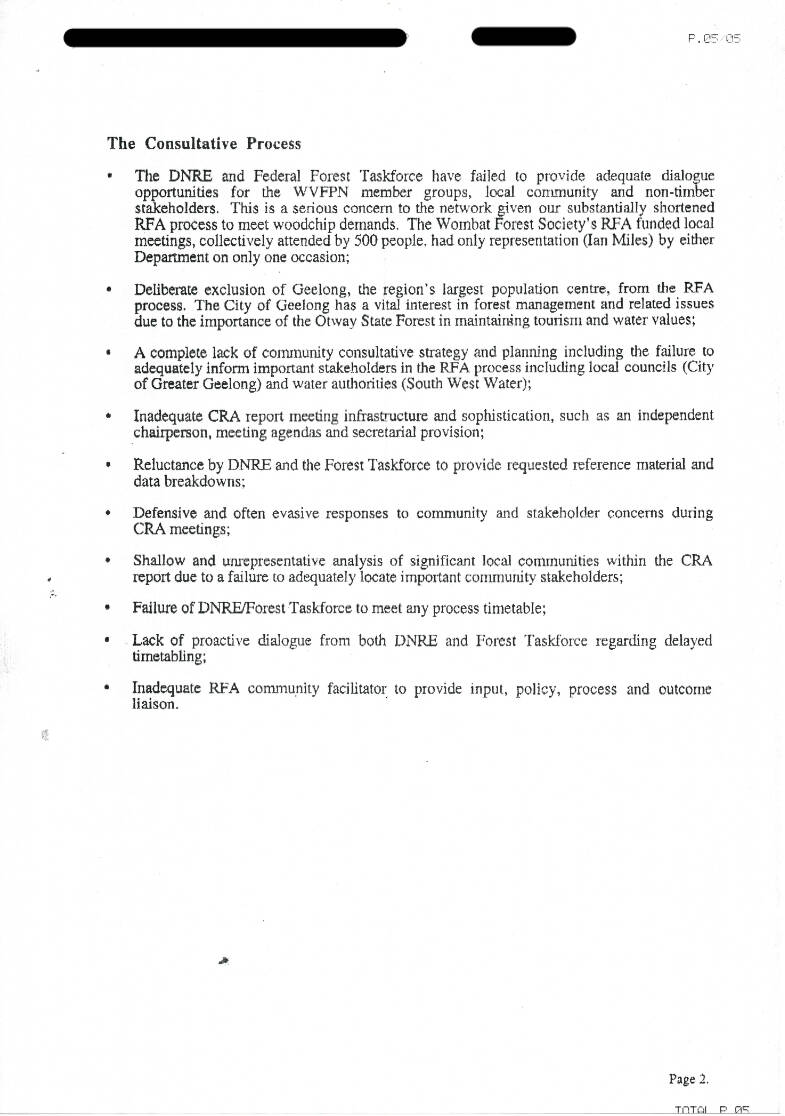
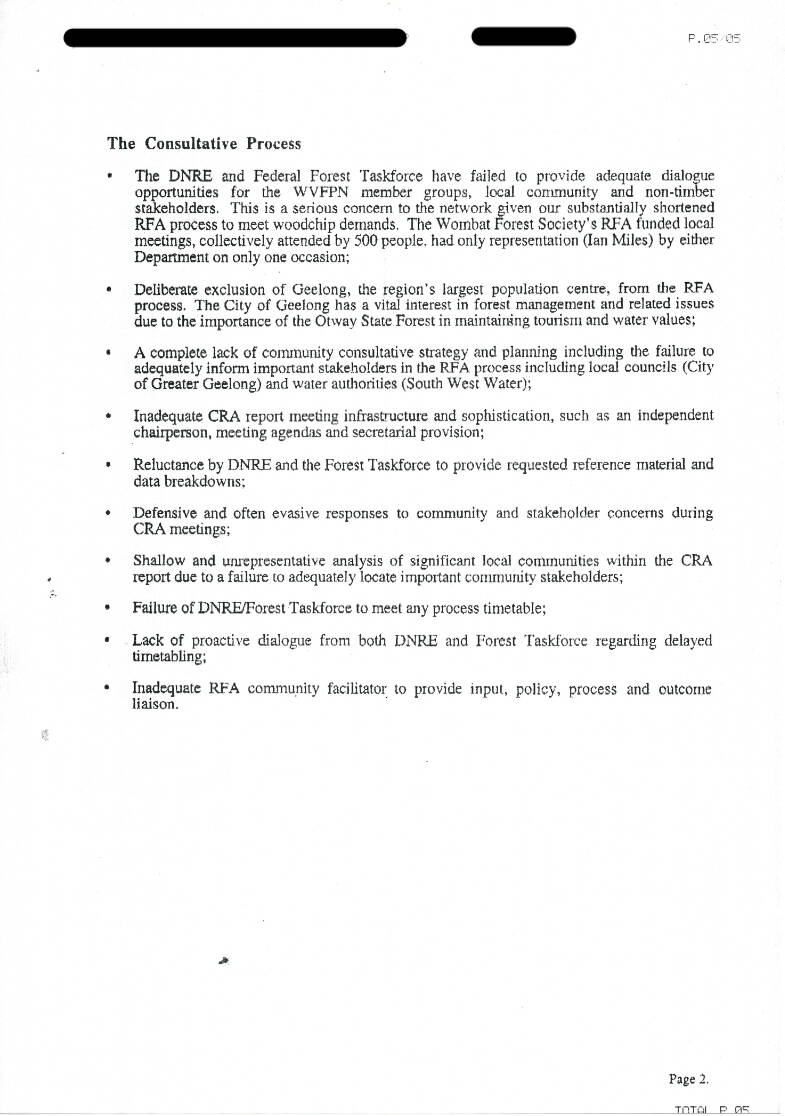
The Western Victorian Forest Protection Network, commonly known as the WVFPN, was established to give regional organisations a stronger and more effective voice in those decisions. Its development brought together the Wombat Forest Society, the Otway Ranges Environment Network, the Geelong Community Forum, the Portland Field Naturalists and a wider collection of conservation and community organisations. These groups possessed different histories, priorities and methods, but they shared a concern that government forest assessments were failing to give adequate weight to ecological values and the knowledge of people who lived and worked near the forests. Rather than surrender the Regional Forest Agreement process to government agencies and industry representatives, the Network sought to enter that process, examine its assumptions, challenge its findings and use the opportunities it created to advance forest protection.
The Network's importance lay in its independence and its practical understanding of political influence. Its members did not regard participation in government consultations as an endorsement of the policies being considered. They regarded it as an opportunity to obtain information, question official claims and place independent evidence before the people responsible for decisions. This distinction was central to their strategy. A conservation organisation could reject unsustainable logging while engaging directly with forestry officials. It could oppose the government's preferred outcome while examining the data upon which that outcome depended. It could also cooperate with other conservation groups without demanding that every organisation adopt identical positions on timber production, direct action or political negotiation.
The Network therefore developed an approach that differed from the boycott strategy adopted by some larger environmental organisations. Its members understood the political appeal of refusing to participate in a process regarded as biased towards logging. They also understood the consequences of leaving the assessment largely in the hands of the institutions whose calculations and management practices were being challenged. The WVFPN chose to investigate the process from within, while retaining the freedom to criticise its deficiencies and oppose its conclusions. The objective was not simply to register opposition. It was to develop evidence capable of changing the decisions themselves.
The Otway Ranges Environment Network's published history independently records the formation and activities of the WVFPN. OREN identifies the Wombat Forest Society, Geelong Community Forum and Portland Field Naturalists among the regional groups involved in establishing the Network and records its role in supporting submissions, organising public meetings, following the RFA process and mobilising opposition across western Victoria. OREN also confirms that the Network received Commonwealth funding to assist regional participation. Its account establishes the WVFPN as an organised and active coalition, rather than an informal association of groups occasionally endorsing one another's campaigns.
oren.org.au+1
A coalition built around the knowledge of regional communities
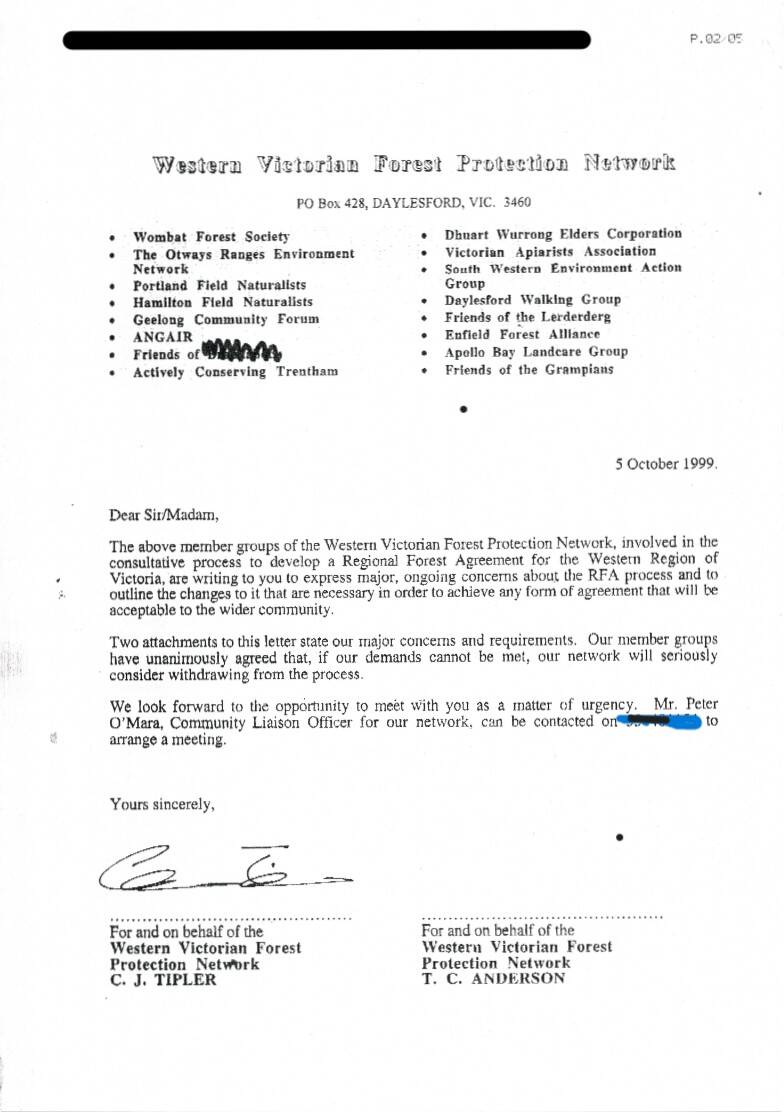
The Western Victorian Forest Protection Network brought together an unusually broad collection of organisations. Its historical membership records identify twenty-one participating groups, representing environmental conservation, field naturalists, community interests, recreation, tourism, Indigenous concerns and other relationships with the forests of western Victoria. The organisations recorded in the Network's historical account were the Otway Ranges Environment Network, Wombat Forest Society, ANGAIR, Enfield Forest Alliance, Actively Conserving Trentham, Daylesford Walking Group, Portland Field Naturalists, Hamilton Field Naturalists, Geelong Community Forum, South West Environment Action Group, Friends of Lerderderg, Ballarat Field Naturalists, Dhuart Warrong Elders Corporation, Victorian Apiarist Association, Enviro West, Apollo Bay Landcare Group, Friends of Bannockburn Bush, Geelong Field Naturalists, Golden Plains Tourism Association, Break O' Day Forest Environment Group and Barwon Biodiversity Watch.
The breadth of these organisations was itself an important statement about forest management. Forests were not simply sources of commercial timber or places of interest to professional conservation campaigners. They were living landscapes with ecological, cultural, economic and community values. Field naturalists possessed knowledge accumulated through years of observing plants, animals and changing forest conditions. Local environment groups understood the effects of harvesting on particular catchments and habitats. Walking groups and tourism organisations valued recreation, landscape character and public access. Apiarists depended upon flowering forests and the continuity of nectar-producing vegetation. Indigenous organisations brought relationships with Country and cultural priorities that could not be reduced to conventional forestry categories. The Network sought to bring these different forms of knowledge into a process otherwise dominated by official assessments and resource calculations.
Its structure reflected this diversity. The WVFPN did not attempt to turn every participating organisation into a branch of a single statewide campaign. Groups retained their own identities, objectives and methods. The Otways organisations could concentrate on water and catchment protection, the Portland naturalists on biodiversity and the ecological condition of south-western forests, and the Wombat Forest Society on sustainable-yield calculations and the management practices underlying timber allocations. Where interests overlapped, organisations could share information, support submissions and combine their political influence. Where their positions differed, those differences did not automatically prevent cooperation.
This was a particularly important principle in a conservation movement often divided over tactics and the future of timber production. The Network demonstrated that cooperation did not require uniformity. Its members could agree that forests required better protection while differing about the role of direct action, the possibility of genuinely sustainable timber production or the merits of engaging with government. The common obligation was to contribute useful knowledge and support the broader effort to improve forest management. By respecting organisational independence, the Network created a structure capable of drawing upon expertise that might otherwise have remained scattered among small regional groups.
The regional basis of the Network also gave it a different understanding of the forest conflict. Its participants lived among the communities affected by government decisions. They knew that forest policy influenced local employment, water supplies, recreation, tourism and relationships between neighbours. They were familiar with the tensions between conservationists and timber workers, but they also understood that both could have legitimate concerns about inaccurate resource assessments and poorly conceived government policies. The Network's approach was to challenge the decisions and institutions responsible for forest management rather than assume that everyone associated with timber production was an adversary.
The Regional Forest Agreement: an opportunity to challenge the system
The West Victorian Regional Forest Agreement was part of a national program intended to establish long-term arrangements for forest conservation and timber production. The process involved comprehensive regional assessments examining biodiversity, forest resources, cultural heritage, water, social and economic values and other matters relevant to future management. The West Victorian assessments covered a geographically extensive and ecologically diverse region, including the Otways, the Wombat and forests around Portland. The Commonwealth's historical archive records the substantial body of assessment material produced during 1999 and early 2000, including biodiversity, social, water-related and forest-industry information. The agreement was ultimately signed on 31 March 2000.
DAFF
For the WVFPN, the assessments presented an opportunity to test the assumptions upon which forest management depended. The Network's members understood that challenging an individual logging operation was only one part of a much larger task. The decisions authorising that operation had usually been made years earlier through forest management plans, timber resource calculations, zoning decisions and administrative assessments. By the time machinery entered a coupe, the essential decisions about timber allocation and harvesting priorities had already been taken. The Network wanted to investigate those earlier decisions and the evidence used to justify them.
The Society's approach in the Wombat was particularly influential. The forestry department claimed that its harvesting allocations were sustainable because they were supported by resource inventories, growth assumptions and computer models. The Wombat Forest Society challenged those calculations by examining the actual forest resource, previous harvesting, regeneration and the assumptions about future timber production. Its members recognised that if the underlying resource calculations were unreliable, the entire justification for continuing harvesting at the allocated rate was weakened. The same principle could be applied across western Victoria: examine the evidence, identify the assumptions, test whether they were defensible and then use the findings to challenge government decisions.
OREN pursued a complementary approach in the Otways. It concentrated heavily on the relationship between clearfell logging, catchment condition and the water resources upon which regional communities depended. Its September 1999 assessment of the West Victorian Comprehensive Regional Assessment examined the official material and challenged the treatment of forest management, timber production, water, tourism and environmental values. This was a substantial analytical response to the government's own documents, demonstrating that regional conservation groups were capable of scrutinising complex policy material rather than relying solely on public protest.
oren.org.au
The Network's strategy was therefore built upon a straightforward proposition: the government's forest assessments should be answerable to the people who knew the forests and to the evidence available about their condition. Participation was a means of applying that scrutiny. It gave regional groups access to government representatives, opportunities to question official information and a formal basis for placing their concerns on the public record. The WVFPN was not seeking merely to be consulted. It was seeking to make consultation consequential.
The Ballarat meeting: bringing the government to the community
One of the most imaginative examples of the Network's approach was its organisation of a regional meeting in an otherwise unused school building in Ballarat. The event was designed to overcome a fundamental weakness in conventional government consultation: small regional organisations often lacked the resources, time and personal connections needed to engage effectively with the numerous agencies responsible for forest assessments. Written submissions could be lodged, but they did not necessarily provide opportunities to question the officials who prepared the reports or to explain local evidence in detail. The Network responded by creating a meeting structure that brought the agencies and the community organisations together in one place.
Representatives of Commonwealth and Victorian government agencies and the RFA working groups were invited to attend. Classrooms were allocated to different areas of the assessment, including biodiversity, water, Indigenous interests, sustainability and recreation. Officials responsible for particular subjects were available in the relevant rooms, while representatives of regional organisations could move between them, present information, ask questions and discuss the issues affecting their own forests. Instead of requiring every community group to navigate a complex bureaucracy independently, the Network created a practical opportunity for direct contact with the people conducting the assessments.
The arrangements also recognised the financial limitations of volunteer organisations. The Network used its available funding to assist with transport, including hiring vehicles where necessary so that people from more distant parts of the RFA region could attend. Transport was also organised for Indigenous representatives, enabling them to participate directly and raise their own priorities. These were practical decisions with considerable significance. Access to government processes is not meaningful if participation depends upon people having the money, transport and time to attend. The WVFPN addressed those barriers rather than treating public consultation as complete merely because an invitation had been issued.
The Ballarat meeting demonstrated how a regional coalition could make government more accessible without becoming dependent upon it. Officials were able to hear detailed local knowledge about forests, wildlife, catchments and community concerns. Regional groups could question assumptions and establish contacts for further correspondence and submissions. The meeting also allowed participants to see how issues in one forest related to those elsewhere in western Victoria. Problems with biodiversity assessment, resource modelling or consultation were not necessarily isolated incidents; they could reflect weaknesses in the broader system.
The arrangements for Indigenous participation were especially important. The Network sought to enable Indigenous representatives to speak for their own interests rather than treating them simply as supporters of a conservation position already developed by non-Indigenous organisations. Cultural heritage, relationships with Country and the responsibilities of Indigenous communities required direct representation. Providing transport and opportunities for discussion was a practical recognition that these interests deserved an independent place within the assessment process. The Network's approach was consistent with its wider philosophy: participation should expand the range of voices influencing decisions, not merely increase the number of organisations endorsing a predetermined position.
The Ballarat meeting remains one of the clearest examples of what made the WVFPN distinctive. It did not simply demand that government listen to regional communities. It created a mechanism through which those communities could speak directly to the relevant officials, present evidence and participate in the decisions affecting their forests.
The Otways: protecting the water that sustained regional communities
The Otway Ranges Environment Network brought to the WVFPN a strong campaign against clearfell logging and its consequences for biodiversity, catchments and the communities dependent upon them. The Otways supplied water to Geelong and other settlements, supported important forest ecosystems and formed the landscape foundation of a substantial tourism and recreation economy. OREN argued that government forestry assessments gave inadequate weight to the relationship between forest harvesting and water production, particularly the effects of replacing mature forest with vigorously growing regrowth following clearfell logging. Its work connected forest conservation with an immediate regional interest: the long-term protection of domestic water supplies.
This emphasis was strategically important. Timber production could be presented as an economic benefit, but reduced water availability also carried economic and social costs. OREN's approach challenged the assumption that forest harvesting could be assessed principally through the commercial value of the timber removed. Catchment condition, water yield, biodiversity and recreation were part of the forest's productive contribution to society, even though their value was not reflected in the forestry department's timber accounts. By bringing water into the RFA debate, OREN strengthened the case that the forest had to be managed for more than commercial wood production.
OREN's contemporary research and subsequent historical accounts document the importance of this campaign. Its September 1999 examination of the Comprehensive Regional Assessment challenged the official treatment of western Victoria's forest resources and non-timber values. Its later submissions continued to argue that the West Victorian RFA had failed to account adequately for the effects of clearfell logging on Otway water catchments. These publications provide independent evidence of the sustained technical and political work that regional organisations contributed to the forest debate.
oren.org.au+1
The WVFPN allowed the Otways campaign to operate within a wider regional effort. OREN's catchment evidence could be presented alongside the Wombat Forest Society's sustainable-yield calculations and the Portland naturalists' biodiversity concerns. This made it more difficult to treat environmental objections as isolated complaints about individual harvesting areas. Across western Victoria, different organisations were identifying weaknesses in the assumptions governing forest management. The Network brought those concerns together and directed them towards the agencies responsible for the Regional Forest Agreement.
Portland and south-western Victoria: natural history becomes political evidence
The forests surrounding Portland and the Cobboboonee area presented different environmental questions from those in the Otways and Wombat. Here, the contribution of local field naturalists was particularly important. The Portland Field Naturalists Club and other south-western organisations possessed detailed knowledge of forest vegetation, wildlife, ecological communities and places of conservation significance. Much of this knowledge had been accumulated through observation and fieldwork rather than through government resource assessments. The Network recognised that such expertise was valuable precisely because it could identify features overlooked by broad-scale official surveys.
Doug Phillips of the Portland Field Naturalists Club and Geraldine Ryan of Environment Victoria later described the club's decision to participate in the West Victorian RFA process, which began in late 1998. Their account records the club joining the regional Network under the chairmanship of Tim Anderson of the Wombat Forest Society. It also describes how the Network enabled regional conservation organisations to engage directly with Victorian and Commonwealth officials across the RFA region. The importance of that arrangement was practical: local knowledge could be placed before the people preparing assessments and negotiating forest management arrangements, rather than remaining confined to local correspondence or public objections.
The Portland experience subsequently developed into a further application of the Wombat Forest Society's technical approach. Environment Victoria, through its forest campaigning work, commissioned Anderson to examine logging and sustainable-yield assumptions in the Portland state forests. Darren Gladman, who had been appointed as an Environment Victoria forest campaigner, was involved in the wider organisational relationships that made this work possible. The commission drew upon the connections developed between the Portland naturalists, Environment Victoria and WFS through the regional network.
Anderson's investigation combined field inspections, discussions with timber industry participants, historical information, local observations and examination of the forestry department's resource calculations. The central question was the same one that had driven the Wombat research: did the actual forest resource support the volumes of timber the department claimed could be harvested sustainably? The assessment examined the condition of the forests, regeneration, biodiversity concerns and the assumptions governing future timber production. By applying a method developed in the Wombat to another forest management area, the work demonstrated that sustainable-yield auditing was not simply a local campaign device. It was an approach capable of being used to scrutinise the wider Victorian forestry system.
The completed Portland assessment was provided to Environment Victoria and sent to Environment Minister Sherryl Garbutt and representatives of the local timber industry. This distribution reflected the WFS philosophy that research should be available to the people whose decisions and livelihoods were affected by it. The Society did not regard environmental evidence as something to be held exclusively within conservation organisations. It believed that credible information should be placed before ministers, departments, timber workers and industry representatives so that arguments about forest management could proceed from a shared examination of the resource.
The Portland campaign eventually contributed to a transition away from native forest logging in the area, alongside government policy changes and industry restructuring. The relationships developed through the WVFPN helped connect the knowledge of local naturalists with technical investigation and statewide political advocacy. The episode demonstrated the value of regional cooperation: people who knew a forest intimately could work with researchers and campaign organisations to challenge the assumptions underpinning its management.
The Wombat Forest: exposing the weakness of sustainable-yield calculations
The Wombat Forest Society's principal contribution to the Network was its systematic challenge to the forestry department's sustainable-yield calculations. The Society had begun by opposing export woodchipping and the ecological consequences of intensive industrial logging, but its members recognised that the department's own timber forecasts offered a means of testing the legitimacy of its harvesting program. If the claimed sustainable supply depended upon unrealistic assumptions about growth, regeneration, available forest area or future silvicultural treatment, those assumptions could be investigated and challenged through evidence.
Anderson and Loris Duclos developed this work through extensive examination of government records, harvesting history, resource assessments and forest management methods. Their research addressed the area of forest already harvested, the consequences of repeated shelterwood operations, the reliability of regeneration assumptions and the department's projections of future sawlog production. It also examined the distinction between the theoretical productivity of a forest and the actual availability of commercially useful sawlogs. The resulting critique challenged the figures being used to justify continued harvesting in the Midlands Forest Management Area.
The West Victorian RFA process provided an opportunity to bring those concerns before Commonwealth officials. The Society's work attracted the attention of Commonwealth Forestry Minister Wilson Tuckey, who commissioned an independent review involving Professors Brian Turner and Ian Ferguson. The review, published in February 2000, placed the Wombat's sustainable-yield calculations under examination by leading forestry academics. The importance of this development was considerable. A regional volunteer conservation society had raised questions about the forestry department's calculations that could no longer be treated simply as local opposition to logging.
The Society continued to challenge the adequacy of the data and assumptions considered in the review. Anderson prepared a detailed response, while Duclos examined the review's treatment of evidence and the implications of its findings. Their work reinforced the need to compare modelled timber production with actual harvesting results, assess the effects of past operations and examine the forest's productive capacity rather than rely upon departmental projections. The dispute extended beyond the Wombat because the same principles of forest inventory, growth modelling and resource allocation were used elsewhere in Victoria.
The political consequences became increasingly significant. The Midlands timber allocation was reduced during the RFA process, but the Society maintained that the revised figure remained excessive. Its continuing research contributed to the wider pressure for independent scrutiny of Victorian sustainable-yield estimates. The subsequent statewide review and the Bracks Government's Our Forests, Our Future reforms in 2002 brought major reductions in official sawlog allocations. In the Wombat, the allocation fell from approximately 41,100 to 8,600 cubic metres annually, a reduction of about 79 per cent. The magnitude of that revision demonstrated how seriously the earlier resource estimates had overstated the forest's capacity to sustain timber production.
OREN's historical account explicitly acknowledges the Wombat Forest Society's contribution to exposing excessive sustainable-yield estimates. It connected the Society's work with the wider challenge to the timber allocations underpinning Victoria's Regional Forest Agreements. This recognition from another regional conservation organisation is important because it demonstrates that the Society's technical work was understood as part of the broader campaign for forest protection, not merely as an argument about commercial timber supplies.
oren.org.au
The Wombat experience became a central illustration of the Network's philosophy. A conservation organisation did not have to confine itself to identifying threatened species or protesting against individual coupes. It could investigate the administrative and technical machinery that authorised harvesting across entire forest management areas. By challenging the models, it could question the scale of logging permitted throughout a region. The result was a form of environmental advocacy directed at the foundations of government policy.
Challenging the RFA timetable: research, law and political negotiation
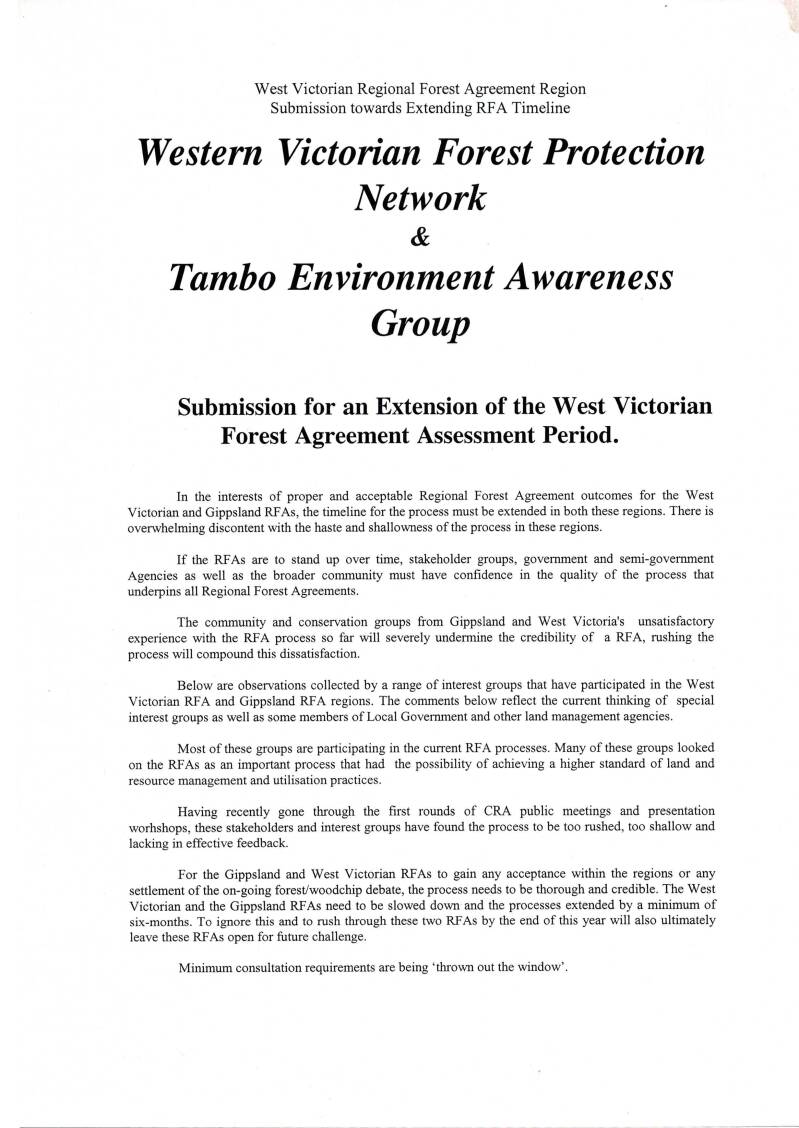
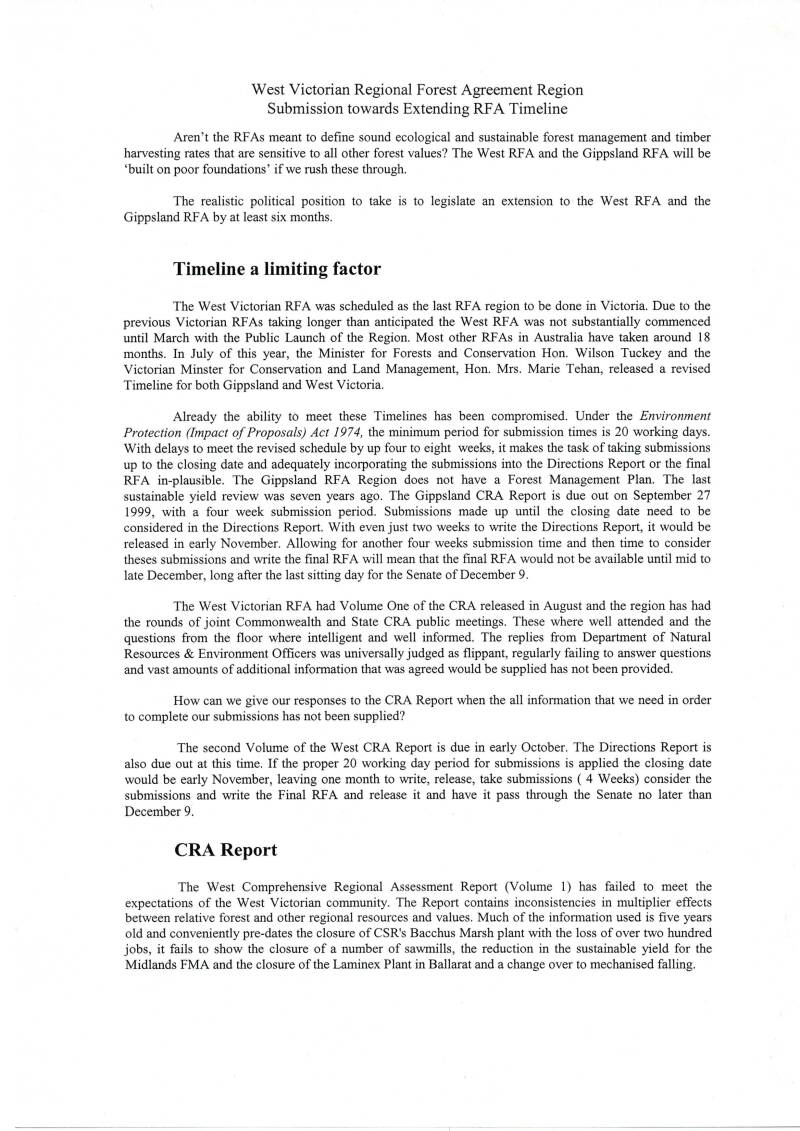
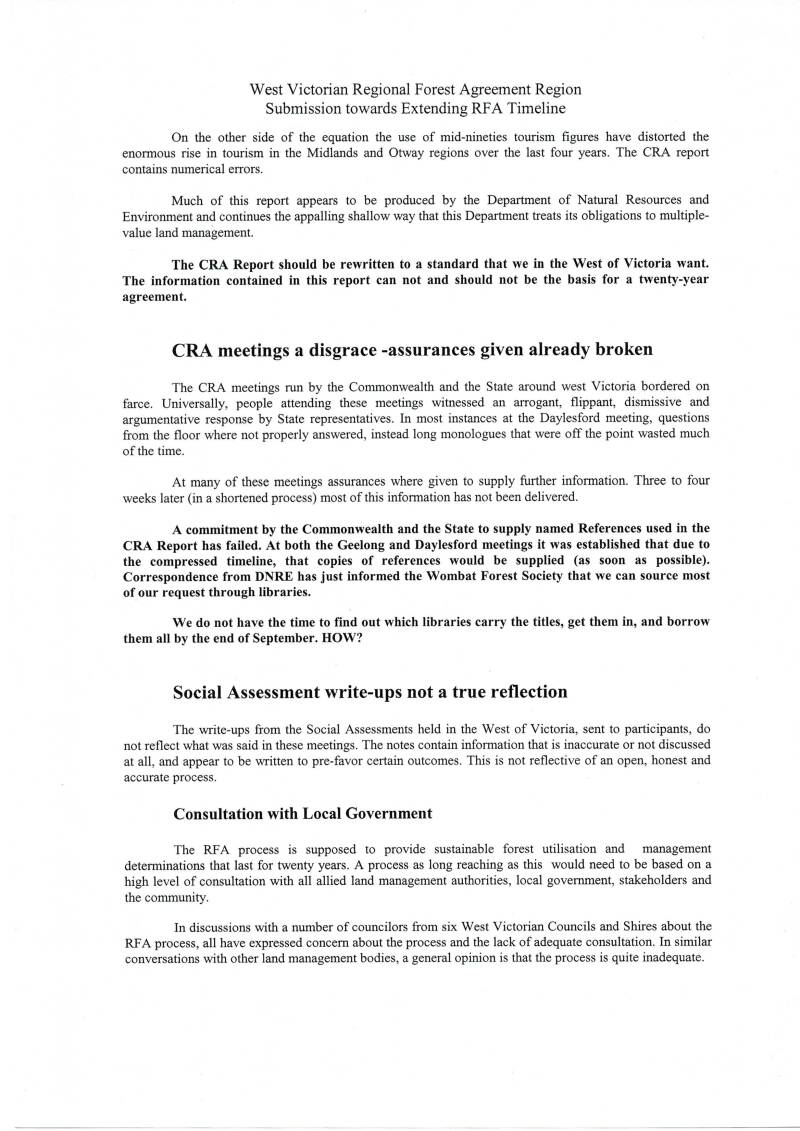
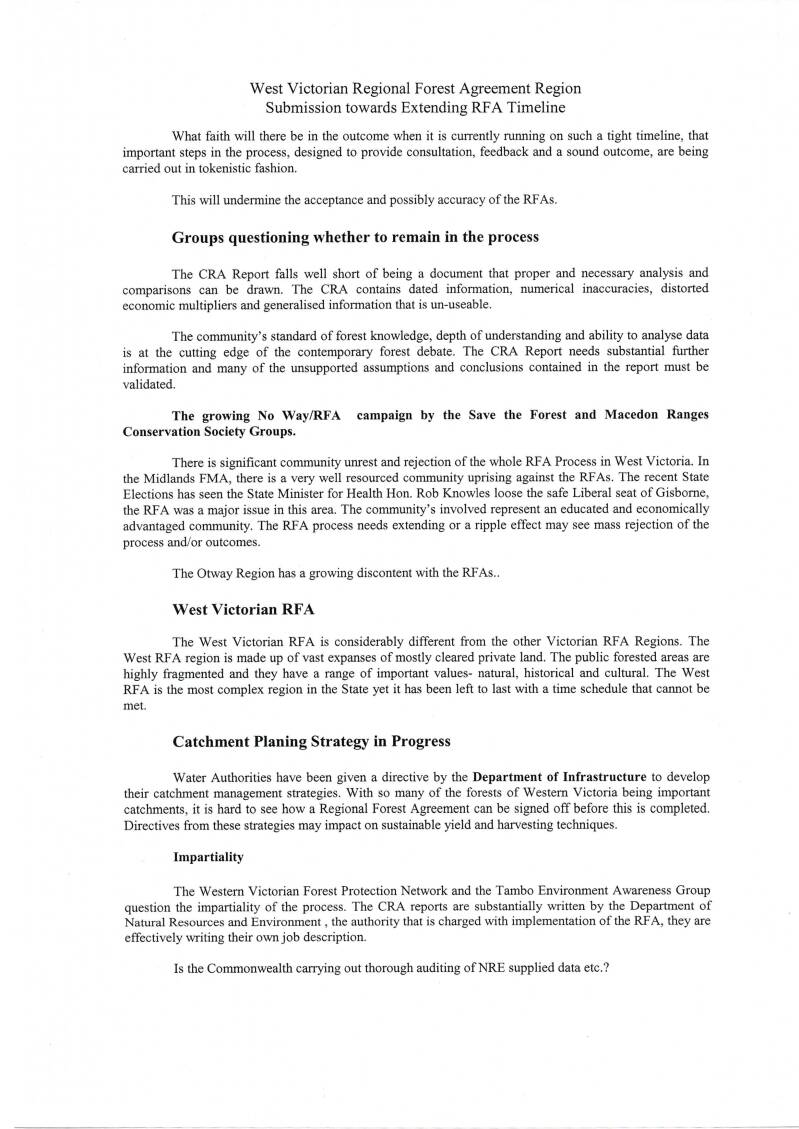
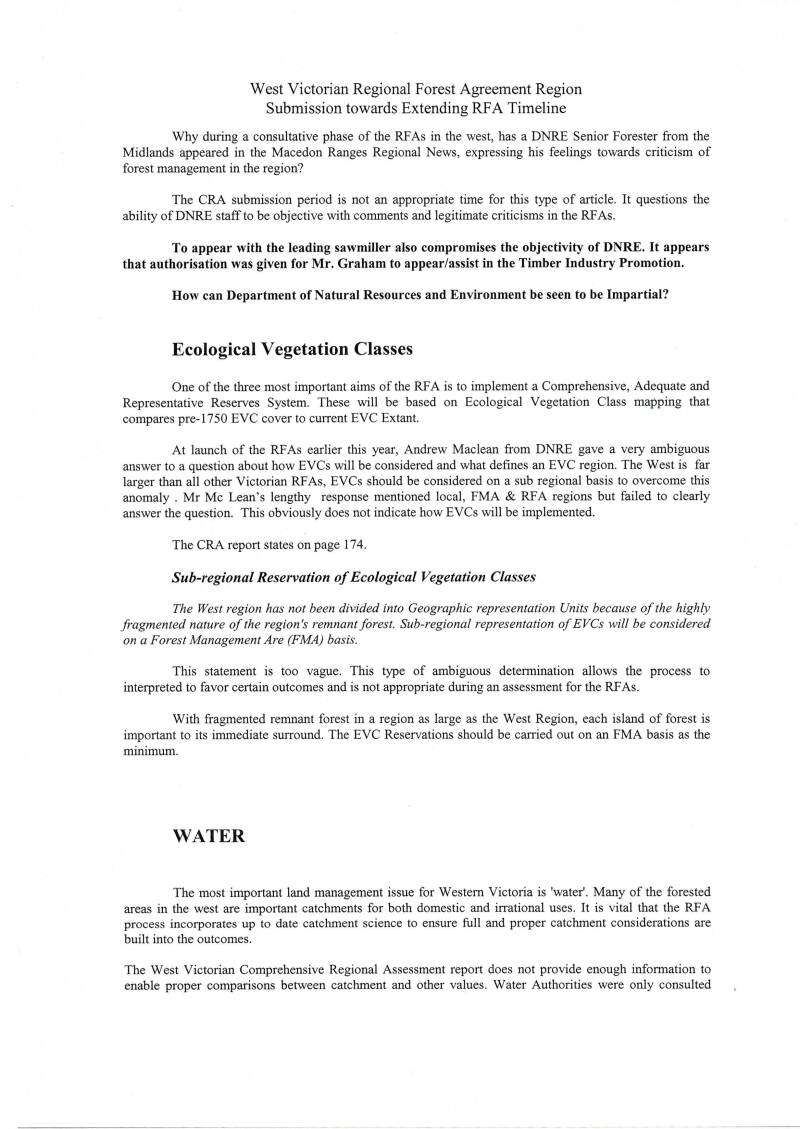
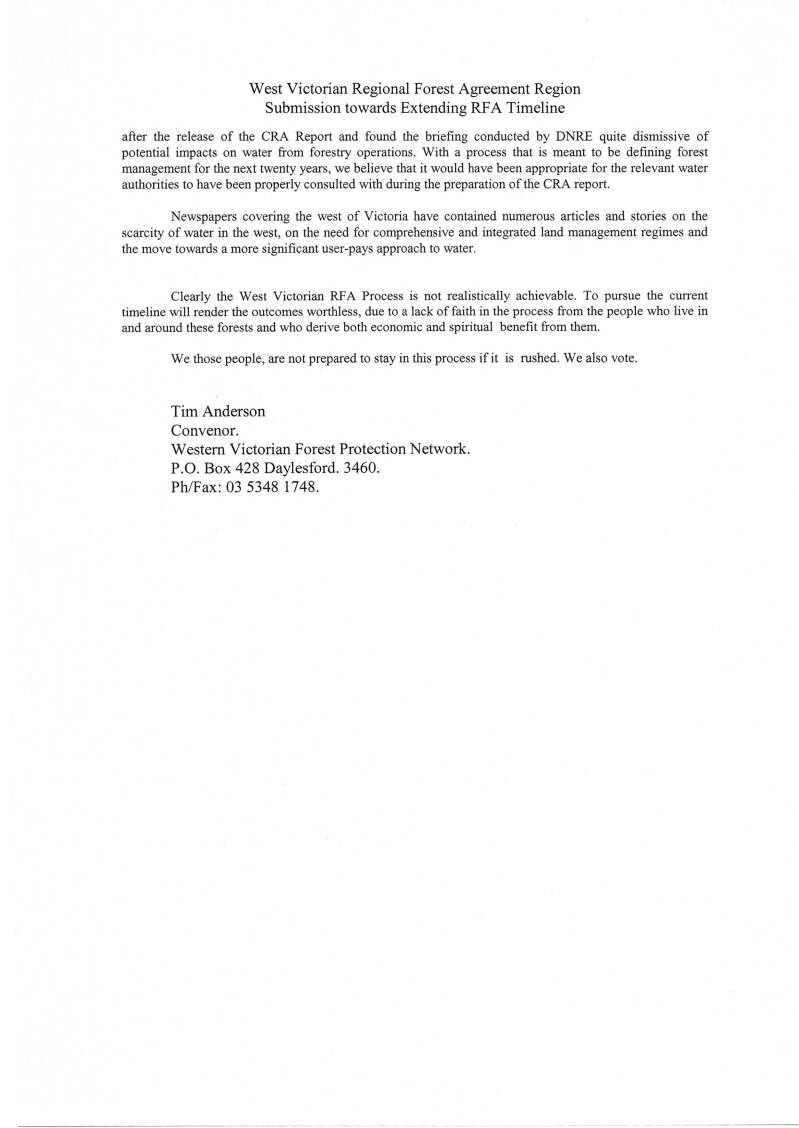
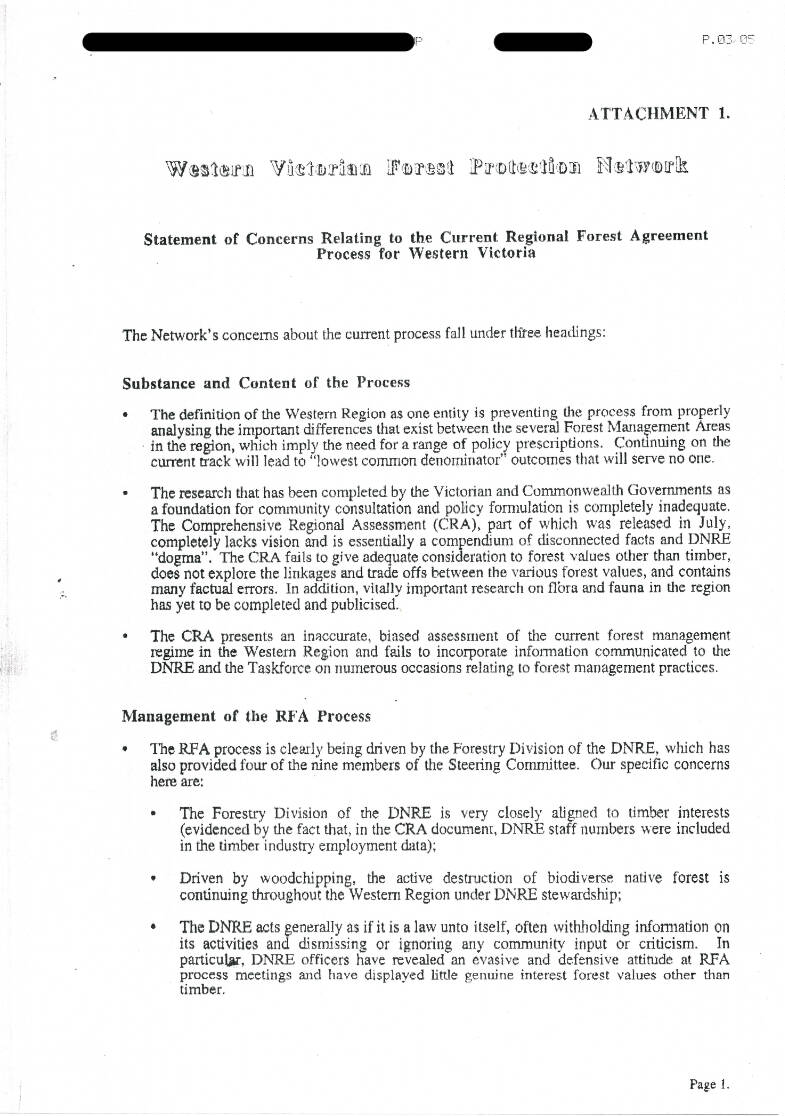
The WVFPN's work was not confined to forest ecology and resource modelling. It also examined the legal and administrative procedures governing the Regional Forest Agreement process itself. As the Commonwealth Government approached its announced deadline for completing the national RFA program by the end of 1999, the Network and the Tambo Environment Awareness Group identified problems with the remaining consultation requirements for the West Victorian and Gippsland agreements. Reports had yet to be released, public consultation periods had to be observed and responses required consideration. The groups recognised that the official timetable was difficult to reconcile with the procedural obligations governing the assessments.
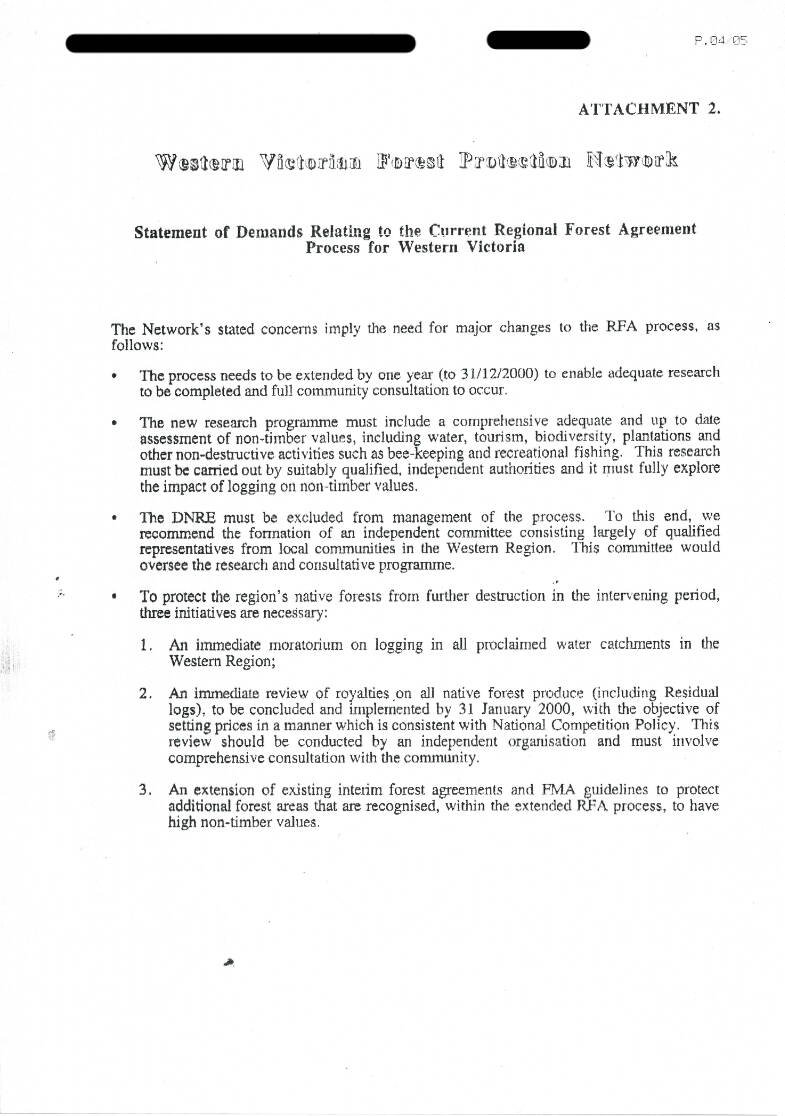
Rather than simply protest against the deadline, they examined the relevant requirements and prepared a joint letter setting out the problem. Their argument was that governments could not legitimately complete the agreements by ignoring consultation procedures. A process intended to settle forest conflict through comprehensive assessment had to comply with its own rules. The groups therefore sought an extension that would allow the outstanding requirements to be completed.
Anderson and Duclos travelled to Canberra and spent two days meeting government ministers and opposition representatives. Their approach was consistent with the political methods developed through the Wombat campaign: identify a specific administrative problem, establish the relevant evidence, present a practical solution and seek support across party divisions. The objective was not to secure a general declaration of sympathy for conservation. It was to obtain agreement to a defined change in the timetable.
The West Victorian and Gippsland agreements were ultimately signed on 31 March 2000, after the original end-of-1999 target had passed. The Commonwealth's official records confirm that date. The Network's archival account records the joint procedural challenge and the Canberra lobbying as part of its effort to secure adequate time for consultation. The episode illustrates the breadth of the WVFPN's work. It was prepared to scrutinise legislation and administrative procedure as well as forestry calculations, and to use direct political negotiation when a practical opportunity arose.
DAFF
The lesson was an important one for regional conservation organisations. Government processes could be challenged through their own procedural obligations. Public consultation was not simply a courtesy offered by departments; it formed part of the framework through which major decisions were made. By examining those requirements and approaching the relevant decision-makers, the Network demonstrated that legal and administrative knowledge could become a powerful instrument of environmental advocacy.
The RFA outcome: participation without surrender
The West Victorian Regional Forest Agreement was signed on 31 March 2000, but its completion did not settle the forest conflict. The Network's members had used the process to advance their particular concerns, yet many remained dissatisfied with the agreement and the assumptions upon which it rested. In the Otways, OREN continued to challenge the effects of clearfell logging on water catchments and biodiversity. In the Wombat, the Society continued questioning timber allocations. Around Portland, local conservationists pursued protection of important forest values and scrutiny of logging practices. The Network's work had created information, relationships and opportunities that could be carried into the next phase of the campaign.
OREN's published history provides a clear account of the continuing opposition. It records the establishment of the WVFPN, the role of the West Victorian Independent Panel in examining public submissions and the large public protest held at the Midway export woodchip mill in Geelong on 4 March 2000. Hundreds of people from western Victoria attended the rally, demonstrating that the approaching agreement had not resolved public opposition to industrial native forest logging. OREN also preserved contemporary newspaper commentary, including Noel Murphy's 31 March 2000 Geelong Advertiser article criticising the RFA process and its treatment of community concerns.
oren.org.au
The Independent Panel's hearings and report became another part of the record of regional dissatisfaction. The public presentation process ran from 17 January to 3 March 2000, and the report was released shortly after the agreement was signed. The controversy illustrated a central weakness in the RFA process: extensive consultation did not necessarily produce public confidence that the resulting decisions reflected the evidence or the concerns presented. For the Network, this reinforced the importance of maintaining independent research and political pressure after the agreement was completed.
The WVFPN's decision to participate had nevertheless produced important benefits. Regional organisations had gained experience dealing with Commonwealth and Victorian agencies, contributed local knowledge to the assessments and developed relationships that could support later campaigns. The Wombat's sustainable-yield figures had come under independent scrutiny, catchment protection had become a central issue in the Otways debate, and naturalists in the Portland area had established stronger connections with organisations capable of supporting technical investigations. The RFA was not the conclusion of those efforts. It was one stage in a longer campaign to change the management of western Victoria's forests.
The subsequent history of the agreement underlines the continuing importance of the issues raised. Victoria's forest policies changed substantially after 2000, and commercial native timber harvesting in state forests ended by 1 January 2024. The Victorian RFAs, including the West Victorian agreement, ceased to operate on 31 December 2024. These later decisions were made in a different political and environmental context, but they demonstrate that the arrangements negotiated in 2000 did not permanently settle the future of native forest management.
deeca.vic.gov.au+1
The Otways conflict: finding common ground between conservationists and timber workers
The period following the West Victorian RFA was marked by increasingly intense conflict in the Otways. Environmental activists continued blockading logging operations, while timber contractors faced interruptions to their work, financial uncertainty and growing hostility around disputed coupes. OREN's campaign history records a succession of actions during the 1999–2000 logging season, including protests at Riley's Ridge, Lardners Creek, Mud Road, Middle Spur and other forest locations. The confrontations brought substantial public attention to the campaign but also created serious tensions between conservationists and timber workers. The Middle Spur dispute in April 2000 became a turning point, prompting government intervention and discussions involving conservationists, forestry officials, industry representatives, the CFMEU, police and ministerial advisers.
oren.org.au
The Wombat Forest Society had already demonstrated that environmentalists and timber workers could find common ground when discussions began with the condition of the forest rather than with accusations about one another's motives. As tensions escalated in the Otways, representatives of both sides approached the Society about ways to reduce the conflict. A meeting was arranged at the Forrest community hall, bringing together sawmillers, logging contractors and conservationists. Tim Anderson and John Endacott attended from the Wombat Forest Society, bringing their experience of working with people who held strongly differing views about forest management.
The meeting began with a deceptively simple request. Participants were asked to explain what they loved about the Otways. Instead of immediately debating logging quotas, blockades or government policy, each person described the values they associated with the forests. The responses revealed substantial common ground. Timber workers and environmentalists alike spoke about the beauty of the Otways, its natural character, biodiversity and the places that made the region special. The disagreement was not about whether the forests possessed important environmental values. It concerned the practices used to harvest timber and the treatment of particular areas where those values were threatened.
One exchange was especially revealing. A logging contractor asked whether OREN representatives had returned to a contentious coupe after harvesting had taken place. He explained that the logging crew had itself recognised the special character of a gully and the surrounding slopes and had refused to log that section. The incident challenged the assumption that timber workers were indifferent to the ecological values of the forests in which they worked. It also demonstrated that conservationists and contractors could sometimes identify the same places as deserving protection, even while disagreeing about the broader future of logging.
The discussion developed into a practical proposal. Rather than allowing every contentious coupe to become the subject of a confrontation after harvesting had been scheduled, environmentalists and timber industry representatives would examine proposed coupes together. They would identify areas where harvesting could proceed and places that should be excluded because of their environmental or other values. The objective was to persuade the forestry department to recognise this process and allow disputes to be addressed before machinery entered the forest.
The meeting concluded with participants continuing their discussions at the Forrest Hotel, a fitting end to an occasion that had begun with people facing one another across a bitter political divide. The important achievement was not that everyone had changed their position on native forest logging. It was that they had discovered a way to discuss specific forest values and develop practical arrangements without treating one another as enemies.
OREN's independent account of the subsequent government-facilitated discussions records arrangements under which contentious coupes were deferred and conservationists received information about harvesting operations. Those arrangements operated during the transition towards the eventual end of clearfell logging in the Otways. The Bracks Government's later phase-out decision and the local efforts to reduce conflict formed distinct but complementary parts of that history.
oren.org.au+1
For the Wombat Forest Society, the Forrest meeting illustrated a principle that had guided its work for years. Timber workers were not necessarily responsible for the government decisions determining harvesting rates, forest zoning or industry restructuring. They were often people with substantial investments in machinery, families dependent upon employment and their own concerns about the future of the forest. Recognising those circumstances did not require conservationists to compromise their environmental objectives. It allowed them to identify where responsibility for damaging policies actually rested and to develop relationships capable of producing change.
Future Rescue and the development of the Wombat Model
The Otways conflict also brought the Wombat Forest Society into contact with activists who had become dissatisfied with the limitations of confrontation-based campaigning. Future Rescue emerged from the direct-action culture of the 1990s, when blockades, tree-sits and other forms of nonviolent intervention were prominent features of campaigns against native forest logging. Its participants included committed environmentalists who were prepared to take considerable personal risks to protect threatened forests. Their experiences nevertheless led some to question whether repeated confrontations with logging crews were sufficient to achieve the wider changes required in forest management.
Some activists contacted the Wombat Forest Society to learn about its combination of research, political engagement and cooperation with timber workers. Their interest reflected frustration with campaigns in which volunteers carried much of the physical burden of direct action while larger organisations received considerable public recognition. The Society's archival account records activists describing their dissatisfaction with being treated as "cannon fodder" by campaign organisers. The phrase expressed their concern that the willingness of volunteers to take risks was not always matched by opportunities to contribute their wider knowledge, education and analytical abilities.
Many of these activists were university students or graduates with interests extending beyond forest blockades. They were capable of undertaking ecological research, examining government records, analysing policy and contributing to technical investigations. The Wombat Forest Society offered an example of how those skills could be applied. Anderson and Duclos had shown that committed volunteers could learn the methods of forestry assessment, challenge official resource calculations and influence political decisions. Their experience demonstrated that environmental campaigning could be intellectually demanding as well as physically courageous.
During visits to the Wombat, some activists met logging crews and shared morning tea with workers at harvesting sites. These encounters were important because they challenged the assumption that the people operating logging machinery were necessarily the principal opponents of conservation. Workers expressed their own concerns about intensive harvesting, the future availability of timber and the consequences of government management decisions. The conversations exposed common interests between people who had previously encountered one another mainly during confrontations in the forest.
The approach became known among participants as the Wombat Model. Its central principle was that effective forest conservation required an understanding of the ecological, technical, economic and political systems governing forest management. Direct action remained one possible method, but it could be strengthened by independent research, community participation, informed political advocacy and respectful engagement with people whose livelihoods were affected by the decisions being challenged.
The relationship between WFS and these activists also produced cooperation on creative public actions, including the Stump Truck campaign in Ballarat. Such activities demonstrated that research-based advocacy did not exclude imaginative protest. The Society's distinction was between action undertaken as part of a broader strategy and publicity that became an end in itself. A public demonstration could attract attention, but the evidence and political work accompanying it were essential to converting that attention into lasting change.
The developing interest in worker–environmentalist cooperation was consistent with a wider social justice movement seeking to overcome the division between environmental protection and employment. The Earthworker initiative, which emerged in the late 1990s, brought environmentalists and trade unionists together around the proposition that ecological sustainability and workers' rights should reinforce one another. Friends of the Earth and participating unions supported approaches that connected environmental reform with secure employment, democratic participation and socially responsible industries.
The Wombat Forest Society's relationships with timber workers offered a practical illustration of the same principle. The people harvesting forests and those campaigning to protect them could both be affected by inaccurate government resource forecasts, poorly planned industry restructuring and decisions made far from regional communities. The Society's experience demonstrated that conservation campaigns could challenge the political and economic structures responsible for environmental damage without treating workers and their families as disposable obstacles to reform.
East Gippsland: extending the technical challenge beyond western Victoria
The influence of the Wombat approach extended beyond the geographic boundaries of the Western Victorian Forest Protection Network. During the Regional Forest Agreement period, the Australian Conservation Foundation assembled a team to examine forestry economics, environmental impacts and sustainable-yield assumptions in East Gippsland. The team included economist Francis Grey, John Dick, Loris Duclos and Tim Anderson, drawing upon experience in environmental analysis, forestry research and regional campaigning.
Anderson's contribution was to apply the sustainable-yield approach developed in the Wombat to the forestry system operating in East Gippsland. The investigation examined the assumptions governing available harvesting area, forest growth, regeneration and the future production of sawlog-quality timber. It also addressed the economic consequences of the silvicultural treatments upon which the forestry department's long-term projections depended.
A particularly important issue was thinning. Government forestry models assumed that regrowth stands would receive treatments designed to concentrate growth into fewer, larger trees suitable for future sawlog production. Yet the extent of the forest requiring treatment raised serious questions about the financial and practical capacity to deliver those operations. Using a theoretical treatment area of 434,500 hectares, the cost would amount to $43.45 million even at $100 per hectare. At $500 per hectare, it would reach $217.25 million. These calculations illustrated the importance of examining whether the operations assumed in a timber forecast were economically achievable, rather than accepting projected yields simply because they appeared in a model.
The East Gippsland work also addressed the ecological consequences of regeneration and forest management practices. Field observations raised concerns about the condition of harvested areas, the composition of regenerating forests and the effects of managing native forests primarily for industrial timber products. These issues connected the technical calculation of sustainable yield with the broader environmental question of what kind of forest the management system was producing.
The significance of the work lay in its potential to challenge forestry policy at the scale of an entire management area. A campaign centred upon threatened species or individual logging coupes could protect particular places, but a successful challenge to the resource calculations underlying the harvesting program could require changes across a much larger area. The Wombat experience had demonstrated the political power of that approach. Applying it to East Gippsland offered another means of questioning the assumptions used to justify native forest logging.
The East Gippsland project did not become the central public instrument of that region's forest campaign. The broader campaign continued to concentrate heavily on threatened habitats, species protection and individual harvesting operations. The contrast illustrated a strategic division within the environmental movement: whether to focus primarily on preventing damage at particular locations or to challenge the administrative and technical systems authorising harvesting across whole regions. The WVFPN's history demonstrates the value of combining these approaches, using local ecological knowledge to inform a wider examination of the forestry system.
A regional network that challenged the conventions of forest campaigning
The Western Victorian Forest Protection Network represented a distinctive development in Australian environmental campaigning because it brought together organisations that were prepared to cooperate without surrendering their independence. Its members recognised that forests had different ecological characteristics and that regional communities possessed different interests and forms of knowledge. The Network did not impose a single campaign model upon the Otways, Portland, Wombat or other areas of western Victoria. Instead, it encouraged each organisation to develop the arguments and evidence most relevant to its own circumstances while supporting the wider effort to challenge government forest policy.
This approach was particularly important during the Regional Forest Agreement process. Some conservation organisations rejected participation because they regarded the negotiations as a mechanism for legitimising continued logging. The WVFPN took the position that participation could be used to expose weaknesses in the government's evidence, obtain information, challenge forestry assumptions and place regional concerns before Commonwealth and Victorian officials. Its members were prepared to criticise the process while using the opportunities it created.
The Network's achievements were practical and varied. It helped regional organisations prepare submissions and engage with government agencies. It brought field naturalists, community representatives and Indigenous participants into direct contact with officials. It supported scrutiny of biodiversity, catchments, timber resources and the procedures governing the RFAs. It encouraged cooperation between groups with different campaigning methods and helped connect local environmental knowledge with technical analysis and political advocacy.
Its work also extended beyond the formal RFA negotiations. The relationships established during the process contributed to subsequent investigations of forestry practices in Portland, the Wombat and other regions. They supported discussions between conservationists and timber workers in the Otways and helped demonstrate that forest conflict could sometimes be addressed through practical negotiation rather than repeated confrontation. They also provided opportunities for activists interested in research and social justice to explore methods beyond conventional blockade campaigning.
The Network's experience challenged the assumption that professional environmental organisations possessed a monopoly on expertise or political influence. Regional volunteers had knowledge of forests that government agencies and metropolitan campaigners did not necessarily possess. When that knowledge was combined with research, organisational cooperation and sustained political engagement, it could influence decisions well beyond the local community.
The Wombat Forest Society's sustainable-yield work was an outstanding example. A small regional organisation developed the capacity to challenge government resource calculations, prompted independent examination by leading forestry academics and contributed to a wider reassessment of timber allocations. OREN's catchment work similarly demonstrated how a regional campaign could connect environmental protection with the practical needs of communities. The Portland naturalists showed how detailed knowledge of flora, fauna and forest condition could become part of formal assessments and subsequent technical investigations.
These achievements were not the product of a single campaign technique. They arose from the willingness of regional organisations to identify the institutions responsible for decisions, understand the evidence upon which those decisions rested and pursue opportunities to change them. The Network's importance was its capacity to bring these efforts together without diminishing the individuality of its members.
The legacy of the Western Victorian Forest Protection Network
The Western Victorian Forest Protection Network was formed during a period when governments were seeking to establish long-term agreements that would settle the future of native forest management. Its members understood that those agreements were being developed through assessments and negotiations in which regional communities needed a stronger voice. Rather than remain outside the process, they organised themselves to participate, investigate and challenge. Their work demonstrated that participation could be critical rather than compliant and that independent evidence could become a powerful instrument of environmental advocacy.
The Network's historical significance extends beyond the immediate results of the West Victorian RFA. It established relationships between organisations across western Victoria, encouraged the sharing of knowledge and provided opportunities for smaller groups to engage directly with government. It recognised the importance of Indigenous participation, the expertise of local naturalists, the environmental value of water catchments and the need to examine the technical assumptions governing timber production. It also demonstrated that environmentalists and timber workers could sometimes identify shared concerns and develop practical arrangements to protect places they both valued.
The most important lesson was that forest conservation required more than opposition to individual logging operations. It required the capacity to investigate how harvesting decisions were made, how timber allocations were calculated, how regeneration and growth were assessed, how environmental values were recognised and how governments could be held accountable for the evidence supporting their policies. The WVFPN brought those questions into the Regional Forest Agreement process and helped turn regional knowledge into organised political influence.
Its members also demonstrated that disagreement within the conservation movement did not have to prevent cooperation. Organisations could differ about the role of direct action, government participation and the future of timber production while still supporting one another's work. The Network's strength was that it allowed different approaches to contribute to a shared objective: improving the protection and management of western Victoria's forests.
The subsequent changes to Victorian forest policy give this history additional significance. The West Victorian RFA was signed in 2000, but the questions raised about timber resources, biodiversity, water and the environmental consequences of harvesting continued to shape public debate. The major sustainable-yield reductions announced in 2002, the transition away from clearfell logging in the Otways and later changes to native forest management demonstrated that the arrangements established through the RFAs were not beyond challenge.
The Western Victorian Forest Protection Network deserves recognition as a substantial regional contribution to that history. It brought together people who understood their forests, developed evidence, challenged government assumptions and sought practical opportunities for change. It treated research as a form of political action, consultation as an opportunity for scrutiny and cooperation as a means of strengthening rather than weakening the independence of regional organisations.
Its central achievement was to demonstrate that regional communities could do more than protest against decisions made elsewhere. They could investigate those decisions, question the evidence, engage the responsible institutions and contribute to changing the policies that governed their forests. In doing so, the Western Victorian Forest Protection Network helped establish a model of environmental advocacy grounded in knowledge, independence, community participation and a determination to make government accountable for the management of public forests.
Sources and archival references
The account above draws on the supplied WVFPN webpage, the Wombat Forest Society's Google Drive archive, contemporary RFA records and OREN's published campaign history.
Wombat Forest Society and WVFPN archival material
The relevant Google Drive records include West Vic Forest Protection Network Members; WVFPN Media Clipping on Formation 1998; West Vic Forest Protection Network Media Release; West Vic Forest Protection Network Letter; WVFPN RFA Extension Docs; Regional vs Metropolitan Environment Groups; Anderson Environment Victoria Portland FMA Sustainable Yield Report plus Media; and WFS newsletters and annual reports from 1999–2002. The supplied historical webpage also preserves accounts of the Ballarat meeting, Forrest discussions, Future Rescue contacts, East Gippsland research and the Network's political strategy.
Published and official sources
1. Australian Government — West Victorian Regional Forest Agreement. Official RFA chronology, original agreement, Comprehensive Regional Assessments, consultation papers and supporting reports.
DAFF
2. OREN — West Victorian Regional Forest Agreement campaign history. Regional cooperation, WVFPN formation, Independent Panel, public protests and contemporary media accounts.
oren.org.au
3. OREN — The Native Forests of Western Victoria, September 1999. Contemporary assessment of the government's Comprehensive Regional Assessment.
oren.org.au
4. OREN — Otway campaign credits, 1995–2002. Independent recognition of the Wombat Forest Society, WVFPN, Portland Field Naturalists and other collaborating organisations.
oren.org.au
5. OREN — Negotiations to prevent Otway forest conflict. Records of the 2000–2001 negotiations involving conservationists, government, timber workers and industry representatives.
oren.org.au
6. OREN — The case for cancelling the West Regional Forest Agreement. Retrospective analysis of the RFA, catchment protection and the role of regional conservation organisations.
deeca.vic.gov.au
7. Victorian Government — Termination of Victorian Regional Forest Agreements. Official record of the conclusion of the RFAs on 31 December 2024.
deeca.vic.gov.au
8. Regional vs Metropolitan Environment Groups, Wombat Forest Society archive. Historical account of WVFPN organisation, the Ballarat meeting, the Forrest discussions, Portland assessment and relationships with other environmental organisations.
9. Knowledge, Evidence-Based Advocacy and Forest Campaign Outcomes, supplied Western Victorian Forest Protection Network webpage.