Djaara Forest Gardening and the Restoration of the Wombat Forest
Bringing cultural knowledge and practical forest management together
Traditional Owner-led forest gardening offers an important opportunity to restore the ecological health of the Wombat Forest while re-establishing the role of Dja Dja Wurrung people in caring for their Country. In a forest extensively altered by gold mining, timber harvesting, intense regeneration burns and decades of inadequate restoration, the Djaara approach provides an alternative to both industrial forestry and a conservation philosophy based largely on leaving damaged forests untouched.
Forest gardening recognises that healthy forests are not necessarily forests without human intervention. Aboriginal people have managed Australian landscapes for thousands of years through cultural fire, selective harvesting, protection of important plants and animals, and practices that maintain the relationships between vegetation, soil, water, wildlife and people.
For Djaara, caring for Country is not simply a technical exercise in vegetation management. Country encompasses living systems, cultural relationships, responsibilities and knowledge passed between generations. The health of the forest and the wellbeing of its Traditional Owners are interconnected.
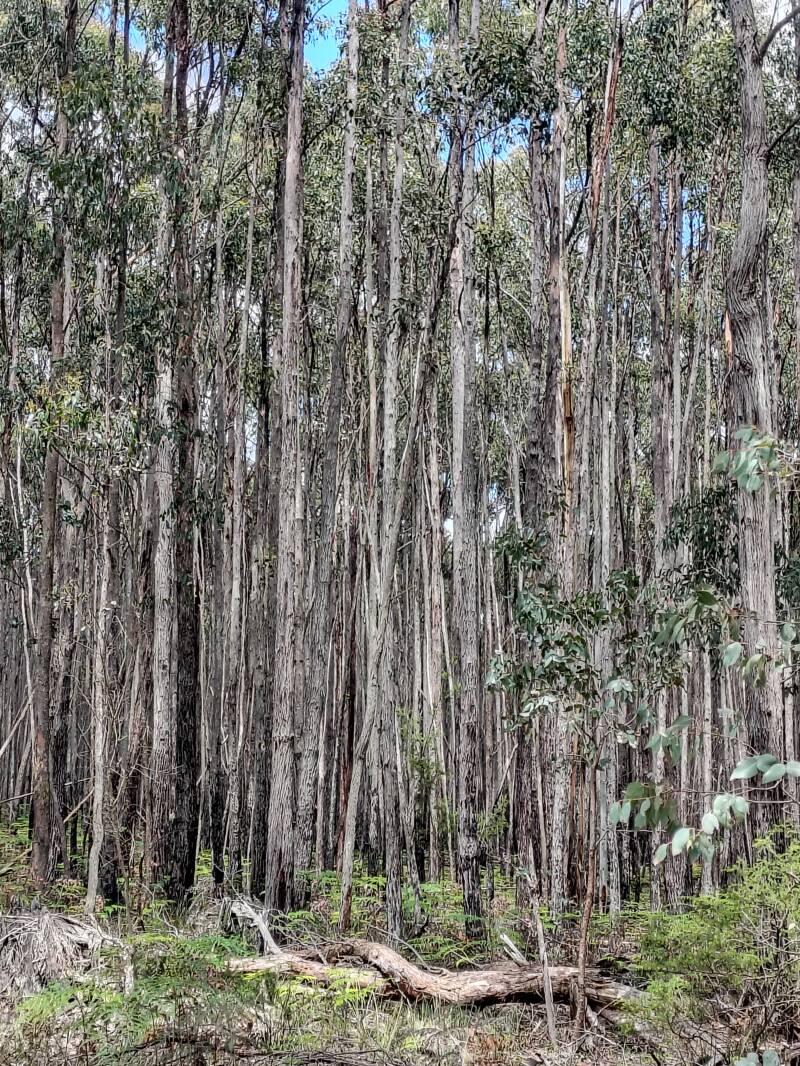
This understanding is particularly relevant to the Wombat, where extensive areas of severely overstocked eucalypt regrowth have resulted from European forestry practices. Some stands contain approximately 10,000 stems per hectare, with trees remaining only a few metres tall after several decades. Their growth is restricted by competition for sunlight, moisture and nutrients, compounded in some areas by shallow soils and the effects of intense regeneration burns.
Djaara forest gardening provides a means of addressing these conditions through carefully planned, small-scale interventions. Cultural thinning, cultural burning, the protection of important vegetation, soil restoration and ongoing observation of Country can be combined to encourage healthier forest development.
The objective is not to return the forest to commercial timber production. It is to restore ecological function, biodiversity and cultural relationships through management directed towards the needs of Country.
Cultural thinning: helping suppressed forests grow
One of the most significant applications of forest gardening in the Wombat is the potential for cultural thinning of severely overstocked regrowth.
Where thousands of small eucalypts occupy each hectare, competition can prevent individual trees from developing healthy crowns and substantial trunks. The forest may remain densely stocked for decades without acquiring the structural complexity associated with mature habitat.
Cultural thinning involves selecting and removing competing stems to improve the growing conditions of retained trees. The work can be undertaken using hand tools and small equipment, avoiding the heavy machinery and extensive soil disturbance associated with industrial harvesting.
Selection is guided by ecological objectives rather than timber value. Retained trees may be chosen for their health, species, location, habitat potential and contribution to the developing forest. Existing hollow-bearing trees, culturally important plants and other significant habitat features can be protected.
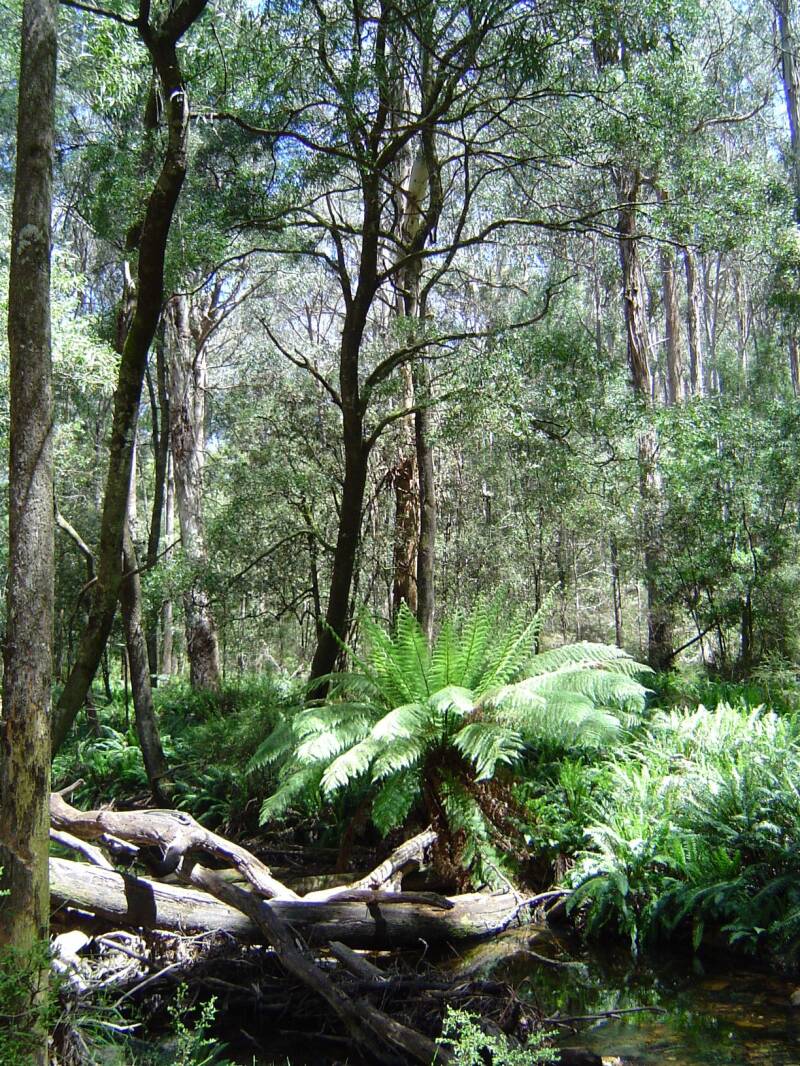
The work can also encourage the recovery of native understorey vegetation. By opening small spaces within dense stands, thinning allows more light to reach the forest floor and can reduce competition for soil moisture. Native shrubs, grasses, herbs and other plants may then have greater opportunities to establish, provided that seed sources and suitable soil conditions remain.
This approach is especially important in the Wombat because the most severely suppressed stands are unlikely to develop rapidly into mature forest without a substantial reduction in competition.
Natural self-thinning will eliminate some trees, but the process may extend over many decades or centuries before a mature forest structure develops. During that period, drought, fire and climate change can interrupt recovery.
Carefully staged cultural thinning offers a means of influencing the forest's development while retaining the capacity to respond to its changing condition.
The small stems removed during treatment can be left on the forest floor where appropriate. As they decompose, they contribute organic matter, provide habitat for decomposers and return nutrients to the soil. Their placement must also consider fire risk, access and the protection of sensitive vegetation.
The ecological principle is straightforward: the purpose of removing selected trees is to improve the health and development of the forest that remains.
Cultural burning: restoring ecological processes without repeating destructive regeneration fires
Cultural fire, known as Djandak Wi, is another important component of Djaara forest gardening. Its purpose is broader than conventional fuel reduction. It can be used to support culturally important plants, maintain vegetation diversity, influence habitat structure and restore ecological relationships.
DJAARA's approach follows the principle of applying the right fire, at the right time, in the right place. This can involve relatively cool, low-intensity fire applied in carefully selected mosaic patterns. Cultural burning is not appropriate everywhere, and its use depends on the condition of Country, vegetation, weather and cultural objectives.
djadjawurrung.com.au
This is particularly important in the Wombat because earlier forestry regeneration burns sometimes involved heavy accumulations of logging debris. Intense burning of these fuel loads damaged shallow soils, consumed organic matter and encouraged mass eucalypt regeneration.
Cultural fire is intended to avoid repeating those destructive outcomes. In suitable locations, carefully managed burning can encourage particular native plants, influence vegetation structure and maintain habitat diversity. Cultural burning and thinning may also be combined, with each intervention designed around the ecological and cultural needs of the site.
Restoring the whole forest, not simply its trees
Djaara forest gardening extends beyond thinning and burning. Its broader objective is to restore the relationships that make Country healthy.
This includes caring for waterways, returning culturally important plants and animals, protecting habitat, encouraging native vegetation and controlling threatening weeds and pests.
An important distinction is that cultural indicators of forest health are not limited to measurements of tree diameter, stem density or vegetation cover. Djaara also considers the presence of culturally significant species, the sounds and seasonal changes of Country, the movement of water, the condition of vegetation and the capacity of people to maintain cultural relationships with the landscape.
These observations complement ecological measurements. Scientific monitoring can quantify changes in tree growth, soil moisture, biodiversity and habitat structure, while cultural knowledge contributes understanding of seasonal processes, relationships between species and the appropriate ways to care for particular places.
The combination creates a more comprehensive approach to forest restoration than either a narrow timber-production model or a management system focused solely on excluding disturbance.
From cultural knowledge to practical management: what is already happening
DJAARA launched its Galk-galk Dhelkunya Forest Gardening Strategy in December 2022. It is a 12-year strategy with an intergenerational outlook, designed to restore cultural landscapes across Djandak, Dja Dja Wurrung Country.
djadjawurrung.com.au+1
The programme has moved beyond policy development into practical demonstration and monitoring.
One of DJAARA's forest gardening demonstration sites. Cultural thinning has been undertaken, with ecological monitoring used to assess forest condition and guide subsequent treatment.
A demonstration site where Djandak Wi has been applied as part of forest gardening, testing the integration of cultural fire with restoration objectives.
A demonstration site where baseline ecological assessments and cultural thinning have been undertaken to restore forest structure and prepare for cultural fire.
DJAARA's 2024–25 annual report records Healthy Country plans for Wombat demonstration sites, informed by biocultural assessments undertaken by DJAARA members and ecological monitoring involving University of Melbourne researchers. It also records thinning at Tobin Track and Paddys Ranges.
djadjawurrung.com.au
This work demonstrates how Traditional Owner leadership and contemporary ecological science can operate together. The University of Melbourne's biocultural monitoring project supports reproducible ecological measurements alongside Indigenous-led assessments, providing a basis for evaluating the environmental, cultural and social outcomes of forest gardening.
Indigenous Knowledge Institute
Why Traditional Owner leadership matters
Traditional Owner-led management is different from simply employing Aboriginal workers to carry out a forest-management programme designed by government agencies.
It places Djaara cultural authority, knowledge and objectives at the centre of decisions about how Country should be cared for.
This means Djaara determining the cultural and ecological values of sites, selecting appropriate treatments, participating in monitoring and deciding how cultural knowledge is shared and applied. Ecologists, government agencies and other specialists can contribute technical expertise while respecting that authority.
The approach also creates opportunities for employment, training and the transfer of knowledge between generations. Cultural thinning, fire management, ecological monitoring, revegetation and restoration of waterways all require practical skills that can support long-term Traditional Owner land-management teams.
DJAARA has emphasised that forest gardening is also an expression of self-determination: restoring the ability of Dja Dja Wurrung people to exercise their responsibilities to Country.
djadjawurrung.com.au+1
Forest gardening and climate change
Climate change makes this approach increasingly important.
The Wombat's severely overstocked stands face growing pressure from hotter conditions, moisture stress and dangerous fire weather. Leaving damaged stands entirely to natural self-thinning could delay the development of mature forest habitat for many decades or longer.
Cultural thinning provides an opportunity to reduce competition, while cultural fire, revegetation and soil restoration can be used to improve ecological resilience where appropriate.
The programme's emphasis on continuous observation is particularly valuable. Management can be adapted as rainfall patterns change, drought affects tree survival or different vegetation communities begin to establish.
Forest gardening does not assume that the Wombat can be restored to one fixed historical condition. It draws on inherited knowledge of Country while responding to contemporary ecological problems and future environmental change.
The combination of cultural observation and scientific monitoring can help identify which treatments are effective, which locations require greater protection and where management needs to change.
The contribution to a Wombat Climate Forest
Djaara forest gardening and the Wombat Climate Forest concept share an important principle: damaged forests require practical ecological restoration, not merely protection against further exploitation.
Both recognise the potential value of carefully selected thinning, the importance of restoring soil and vegetation health, and the need to develop resilient forest habitat under changing climatic conditions.
A Wombat Climate Forest could provide a broader framework within which Traditional Owner-led forest gardening, ecological research, biodiversity protection and long-term monitoring are supported. Such an arrangement would need to respect Djaara's independent cultural authority and the responsibilities of the other Traditional Owners of the wider Wombat landscape.
The ecological benefits of cultural thinning should be evaluated through long-term comparisons of treated and untreated stands. Changes in tree growth, understorey diversity, soil condition, carbon storage and wildlife habitat would provide evidence of restoration outcomes and help refine future management.
The most important contribution of forest gardening, however, is its integration of cultural responsibility with ecological action. It recognises that caring for a forest means understanding its condition, responding to its needs and maintaining a relationship with Country over generations.
Conclusion
Djaara forest gardening offers the Wombat Forest a practical pathway towards ecological recovery. Through cultural thinning, Djandak Wi, revegetation, waterway restoration and ongoing monitoring, Traditional Owners are applying inherited knowledge alongside contemporary ecological science to address the damage left by past land management.
Its importance extends beyond individual restoration techniques. It establishes a different relationship between people and the forest, in which deliberate, carefully considered intervention can be an expression of conservation rather than exploitation.
The Wombat's most severely damaged regrowth will not become mature, resilient habitat simply because commercial logging has ceased. Restoring its ecological function requires long-term attention to tree competition, soil health, vegetation diversity, wildlife habitat and climate change.
Djaara forest gardening demonstrates that the future of forest conservation can be built around caring for Country through informed, measured and continuing action — with Traditional Owners leading the work of healing the landscapes their ancestors cared for over thousands of generations.