The Great Plantation Divide: How Victoria’s Forest Movement Split Over Native Forest Logging, Industrial Plantations and the Meaning of Sustainable Forestry
A historical essay on the Victorian environmental movement, the 1990s forest campaigns, the emergence of the no-native-logging objective, and the development of the Victorian Plantation Management Position Statement, 2001.
The Great Plantation Divide
How Victoria's forest conservation movement divided over native forest logging, industrial plantations and the meaning of environmentally responsible forestry
A movement united against forest destruction, but divided over what should replace it
During the 1980s and 1990s, Victoria's forest conservation movement became one of the most influential environmental forces in Australia. Campaigns against old-growth forest destruction, export woodchipping, intensive timber harvesting, threatened-species habitat loss and the conversion of native forests into industrial plantations brought together environmental organisations, scientists, field naturalists, regional communities, Indigenous representatives and people with direct experience in the timber industry. They shared a determination to challenge forestry practices that were damaging Victoria's native forests, yet beneath that common purpose lay a disagreement about the future of timber production. As the movement developed, some organisations increasingly adopted the objective of ending commercial logging in native forests altogether and transferring timber production to plantations. Others argued that the environmental problem was not simply where the timber came from, but how the trees were grown, harvested and processed, what ecological values were sacrificed, and whether the resulting industry was genuinely sustainable.
The distinction was fundamental. For organisations advocating an end to native forest logging, plantation forestry offered a politically attractive alternative. Native forests could be protected from commercial harvesting while plantations supplied the timber, pulpwood and paper fibre required by society. The proposition was straightforward, readily understood by the public and capable of uniting campaigners around a single objective. It also offered governments an apparent resolution to a conflict that had become increasingly difficult to manage. Timber production could continue, employment could be redirected towards plantations, and native forests could be protected from further industrial harvesting. Yet the simplicity of the proposal concealed an important environmental question. If the plantation industry relied upon large-scale monocultures, intensive site preparation, herbicides, insecticides, fertilisers, repeated clearfelling and the concentration of land ownership in major corporations, had the environmental movement solved the problem of industrial forestry or merely transferred it to another landscape?
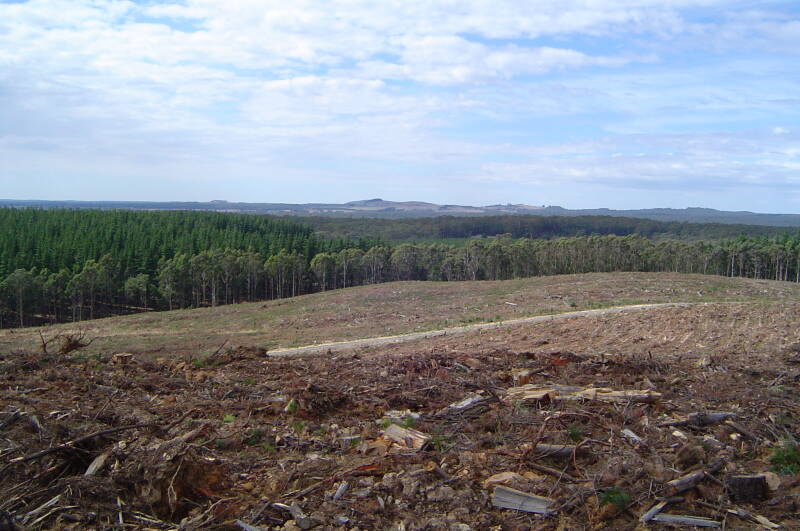
For the Wombat Forest Society, Friends of the Earth and other conservationists concerned about plantation management, this was not a theoretical objection. In regional Victoria, people had witnessed native forests cleared for exotic pine plantations, productive agricultural land converted into industrial tree crops, drainage patterns altered by plantation establishment, and extensive areas of plantation timber harvested through clearfelling. Some plantations contained important native vegetation remnants and wildlife habitat, yet these values were vulnerable to the same commercial pressures that conservationists had challenged in native forests. Plantation development could affect water supplies, soil condition, biodiversity, rural employment and the social fabric of small communities. It was therefore impossible to regard all plantation timber as environmentally preferable merely because the trees had been planted rather than naturally regenerated.
The Wombat Forest Society's position arose from its experience in a community where forestry, farming, conservation and rural employment were closely connected. Its original objectives included ending export woodchipping from the Wombat, reducing timber harvesting to sustainable levels, protecting biodiversity and catchments, improving forest management and encouraging appropriately located plantations on degraded agricultural land. It did not begin with an ideological objection to every use of native hardwood. It challenged the industrial system that was harvesting timber beyond sustainable limits and damaging the ecological values of public forests. Equally, it did not consider the establishment of a plantation sufficient evidence of environmental responsibility. A plantation that destroyed native vegetation, depleted water resources or depended upon environmentally damaging management practices could be as legitimate a subject for conservation campaigning as destructive native forest logging.
The disagreement exposed a weakness in the developing political language of forest conservation. The campaign to end native forest logging was directed at a clearly identifiable source of ecological damage, but the accompanying promotion of plantations involved a separate proposition that required independent examination. The environmental movement could achieve an important conservation objective by removing industrial harvesting from native forests while still failing to address the environmental costs of the replacement timber industry. The issue was not whether native forests and plantations possessed equal ecological value; they plainly did not. It was whether environmental standards should be applied consistently to all forms of commercial forestry. This question became the foundation of an important and largely overlooked initiative in 2001, when Victorian environmental organisations attempted to define what an environmentally acceptable plantation should actually look like.
The Routleys' warning: the problem was industrial forestry itself
Nearly three decades before the Victorian plantation debate reached its most significant point, Richard and Val Routley had identified the danger at the heart of Australia's forestry system. Their influential 1973 book, The Fight for the Forests: The Takeover of Australian Forests for Pines, Wood Chips and Intensive Forestry, was a sustained challenge to the economic assumptions, political relationships and ecological consequences of industrial forestry. Written by two philosophers who later became known as Richard Sylvan and Val Plumwood, the book examined the expansion of pine plantations, the growing export woodchip industry and the transformation of native forests into resources managed primarily for commercial timber production. It questioned the claim that increasing wood production was necessarily in the public interest and criticised the close relationship between government forestry agencies and the industries whose activities those agencies were expected to regulate.
books.google.com+1
The Routleys' central concern was the industrialisation of forests, not simply the harvesting of native trees. They examined a forestry philosophy in which complex ecosystems were reduced to calculations of merchantable wood volume, anticipated growth and commercial returns. Native forests were being assessed for their capacity to supply timber and woodchips, while extensive areas were earmarked for conversion into exotic softwood plantations. Ecological values, biodiversity, water, soils, recreation and other public benefits were subordinated to industrial production. The authors argued that the economic justification for these developments was itself questionable because many of the environmental and social costs were excluded from official assessments. Their critique was directed not only at particular harvesting operations but at the institutional arrangements and assumptions that allowed destructive forestry policies to be presented as rational management.
The importance of their warning became even clearer in Val Plumwood's 2004 retrospective, The Fight for the Forests Revisited. Plumwood recalled that one of the original motivations for writing the book had been the enormous program of exotic pine plantation development in south-eastern Australia. Native forests were being cleared, windrowed and burnt to establish plantations of radiata pine and Douglas fir, with little attention to the ecological consequences. The very government agencies entrusted with managing public forests were participating in the destruction of native ecosystems to establish more commercially productive tree crops. This experience shaped the Routleys' understanding that plantation development could itself be a major cause of forest destruction.
socialsciences.org.au
Their argument was remarkably prescient. By the 1990s, sections of the environmental movement were advocating plantations as the preferred alternative to native forest logging, even though the expansion of industrial plantations had been one of the principal threats identified by two of Australia's most influential early forest conservation thinkers. The contradiction was not that plantation forestry could never be environmentally responsible. The Routleys' warning was that replacing one industrial forestry system with another did not necessarily address the causes of ecological damage. A plantation established through the destruction of native vegetation, managed for maximum commercial output and harvested through repeated intensive operations could reproduce many of the problems that conservationists had spent decades opposing.
Their book also challenged the political authority of forestry institutions. Richard Routley and Val Plumwood later documented the hostility that The Fight for the Forests attracted from professional foresters and sections of the Australian National University. The controversy reflected the extent to which their criticism challenged established assumptions about the role of forestry agencies and the legitimacy of industrial development in public forests. Despite that opposition, the book became an important influence on Australian environmental thought and forest conservation campaigning. John Dargavel's 2004 retrospective placed its significance within the longer history of unresolved conflicts over forest management, public values and institutional authority.
documents.uow.edu.au+1
The Routleys' work provides an essential intellectual foundation for understanding the Victorian plantation debate of 2000–2001. Their warning was not exhausted by the objective of ending native forest logging. It demanded that forestry itself be examined: its economic purpose, its methods, its environmental consequences and its relationship with the public interest. Whether trees were naturally regenerated eucalypts, planted radiata pine or commercially grown blue gums, the ecological and social consequences of their production remained matters of public concern. The 2001 Victorian Plantation Management Position Statement was a practical attempt to recover that broader principle. It sought to establish that plantations could only be considered environmentally responsible when their location, design, management and accountability met defensible ecological and social standards.
From forest protection to the no-native-logging objective
The modern Victorian forest conservation movement developed through overlapping campaigns rather than through a single organisation or philosophy. The Little Desert controversy of the late 1960s helped establish nature conservation as a major political issue, while the following decades brought growing public concern about rainforest destruction, old-growth logging, threatened species, water catchments and export woodchipping. In East Gippsland, the Otways, the Central Highlands and western Victoria, conservation organisations increasingly challenged the assumption that public native forests should be managed primarily for timber production. The Wilderness Society and Australian Conservation Foundation became prominent statewide and national voices, while regional organisations such as the Otway Ranges Environment Network, Wombat Forest Society, Portland Field Naturalists Club and Tambo Environment Awareness Group developed campaigns based upon their own forests, communities and environmental concerns.
Initially, much of this campaigning was directed at particular practices and places. Conservationists opposed the destruction of rainforest, the harvesting of old-growth habitat, logging in sensitive catchments, the removal of trees used by threatened wildlife and the expansion of export woodchipping. They challenged harvesting quotas that appeared inconsistent with the condition and productive capacity of native forests. Over time, however, significant sections of the movement concluded that the failures of government forest management were too extensive and persistent to be resolved through incremental reform. They increasingly advocated ending commercial native forest logging altogether, with plantations promoted as the replacement source of timber.
There were substantial reasons for this development. Intensive clearfelling and shelterwood operations had altered the structure of extensive areas of native forest. Logging roads and heavy machinery disturbed soils and drainage systems. Export woodchipping created markets for large quantities of lower-grade timber and increased pressure on forests already being harvested for sawlogs. Threatened-species protection was frequently contested, while the adequacy of regeneration and sustainable-yield calculations remained disputed. The Wombat Forest Society's investigation of the forestry department's timber resource models added another dimension to these concerns by challenging the reliability of the calculations used to justify industrial harvesting. The evidence accumulated over decades persuaded many conservationists that the existing forestry system was incapable of protecting ecological values adequately.
Ending native forest logging therefore became an understandable and powerful conservation objective. It promised to remove a major source of disturbance from native ecosystems and reduce the need for continuous battles over individual logging coupes. It also provided campaigners with a clear public message. Instead of explaining the complexities of sustainable-yield modelling, forest inventory, regeneration systems and ecological thresholds, organisations could demand that native forests be protected and timber production transferred to plantations. Yet the environmental case for ending destructive native forest harvesting did not establish that every form of plantation production was acceptable. The two propositions were different, and the failure to examine them separately became a source of disagreement within the movement.
For organisations such as the Wombat Forest Society, the question was not whether forests should be protected from destructive logging; that was the foundation of their campaigning. The question was whether commercial timber production could be made ecologically responsible, whether some forms of carefully limited native hardwood production might be compatible with forest conservation, and whether industrial plantations should be subjected to the same rigorous scrutiny as native forest operations. These organisations also recognised the consequences for regional communities. The closure of local native hardwood industries could remove employment from small towns while transferring timber production to large plantation corporations whose operations did not necessarily provide equivalent local benefits. The movement therefore faced questions about environmental protection, industrial structure, economic control and social justice that could not be resolved simply by changing the source of the timber.
The alternative philosophy: reform forestry rather than simply relocate it
The Wombat Forest Society's approach was shaped by a history that made an unquestioning endorsement of plantations particularly difficult. During the 1970s, communities around the southern Wombat had opposed proposals to clear extensive areas of native eucalypt forest and replace them with exotic pine plantations. They understood plantation development not as an alternative to forest destruction but as one of the mechanisms through which that destruction could occur. Their later campaign against export woodchipping and unsustainable native forest logging therefore developed alongside an awareness that planted forests could also be managed destructively. The Society's position was that timber production should be judged by its environmental consequences, not by a simple distinction between native and plantation trees.
This approach also recognised that the timber industry was not a single, uniform enterprise. A small regional sawmill processing limited quantities of durable native hardwood operated within a different economic and environmental context from a large pulpwood enterprise supplying industrial markets. Equally, a mixed-species plantation established on degraded agricultural land and managed to protect soil, water and native vegetation was fundamentally different from an extensive industrial monoculture established through the clearing of native forest. The Society sought to distinguish between these forms of production rather than condemn or endorse entire categories without examining their actual impacts.
The Western Victorian Forest Protection Network provided an organisational example of how different approaches could coexist. During the West Victorian Regional Forest Agreement process, the Network brought together conservation groups, field naturalists, Indigenous representatives and regional community organisations with different priorities. The Otway Ranges Environment Network concentrated heavily on catchment protection and forest conservation, the Wombat Forest Society investigated sustainable-yield calculations, and field naturalists around Portland examined biodiversity and the ecological condition of south-western forests. These organisations did not require agreement on every aspect of forest policy before cooperating. They recognised that independent research, community knowledge and political engagement could strengthen their common objectives.
This philosophy contrasted with the approach of organisations that regarded participation in government forest assessments as legitimising a fundamentally flawed process. The Network's members believed that engaging directly with the assessments provided opportunities to obtain information, question official calculations and challenge the assumptions used to justify logging. Their position was that participation did not require acceptance of the government's conclusions. The same principle applied to plantations: accepting that plantations could supply timber did not require accepting every plantation as environmentally responsible.
The disagreement therefore concerned more than campaigning tactics. It reflected different understandings of environmental reform. One approach sought to remove industrial timber production from native forests, while another sought to change the ecological and social conditions under which timber production occurred. These objectives could overlap, but the difference became significant when the environmental movement was asked to support large-scale plantation expansion without first defining the standards such plantations should meet.
The environmental costs of industrial plantation forestry
Industrial plantations are often managed to produce trees of predictable species, age, size and commercial quality. The system commonly involves uniform stands, intensive establishment, commercial harvesting and replanting for successive rotations. This model can be efficient for timber production, but its environmental consequences depend upon the previous land use, plantation species, soil conditions, rainfall, catchment characteristics, harvesting methods and retained native vegetation. A plantation established on degraded agricultural land can provide a renewable timber resource and may improve some environmental conditions. A plantation established by clearing native forest or managed without adequate safeguards can create serious ecological damage.
Clearfell harvesting is one of the most visible concerns. When an entire plantation compartment is harvested over a short period, the canopy is removed and the site is exposed to the effects of machinery, rainfall, wind and subsequent establishment operations. Heavy equipment can compact soils, disturb drainage lines and create conditions for erosion. Roads, snig tracks and stream crossings can contribute sediment to waterways if poorly designed or maintained. Where adjoining compartments are harvested within a relatively short period, the cumulative disturbance can extend across substantial areas of a catchment. These impacts are not identical to the loss of an established native forest, with its more complex structure and ecological relationships, but they remain environmental costs that must be assessed.
The repeated nature of plantation production adds another dimension. A commercial plantation may be harvested and replanted several times over the period during which a native forest develops its mature habitat characteristics. Each rotation can involve harvesting, site preparation, weed control, planting and other management interventions. Where residues are repeatedly removed or soils are disturbed, nutrient balances and soil structure become important considerations. The environmental consequences are influenced by the amount of organic material retained, the intensity of machinery operations and the measures adopted to protect the soil between rotations. Industrial plantation management cannot be assessed solely by the rate at which the trees grow.
Chemical use was another central concern of the Victorian plantation campaigners. Herbicides may be applied to control competing vegetation during establishment, insecticides used to manage damaging pests, and fertilisers added to increase growth or address nutrient deficiencies. The environmental implications depend upon the chemicals selected, the quantities applied, the method of application, weather conditions, soil characteristics and proximity to waterways or sensitive ecosystems. Potential effects include spray drift, contamination of drainage systems, impacts on non-target vegetation and organisms, and cumulative pressures on aquatic environments. Aerial spraying raised particular concern because it could expose areas beyond the intended treatment site.
The Hancock Watch archive preserves extensive documentation of these issues, including historical plantation maps, chemical-use information, catchment investigations and accounts of forestry operations. Its records identify chemicals associated with Victorian plantation management, including glyphosate, hexazinone, clopyralid, metsulfuron-methyl, glufosinate-ammonium and haloxyfop-methyl, as well as insecticides such as alpha-cypermethrin, fipronil and dimethoate. These substances have different properties and environmental risk profiles, making the details of application and exposure important. The archive also reports substantial chemical use across plantation estates, including its account of glyphosate and hexazinone applications in 2011–2012. The value of this historical material lies in identifying the particular chemicals, locations and management practices that campaigners sought to bring under public scrutiny.
hancockwatch.nfshost.com
Water catchments presented another major concern. Fast-growing plantations intercept rainfall and use water through evapotranspiration. Their effects on streamflow and groundwater depend upon plantation species, age, density, rainfall, soils, previous vegetation and the proportion of a catchment occupied by plantations. Establishing dense tree plantations on previously cleared land can reduce water yield, while harvesting can temporarily change the movement of water through the landscape. Deep ripping, contour preparation and other establishment practices can alter infiltration and local drainage patterns. In catchments already experiencing declining rainfall or increasing competition for water, these effects can have substantial consequences for farms, towns and aquatic ecosystems.
Hancock Watch's mapping of plantations within Victorian water supply catchments illustrates why these concerns became politically important. Its investigations extended across the Strzelecki Ranges, the Otways and other plantation regions, identifying places where forestry operations intersected with waterways, rainforest gullies and domestic water supplies. The archive's catchment-by-catchment approach challenged the treatment of plantations as isolated timber production units. It examined their position within the wider landscape and the consequences of forestry practices for downstream communities.
hancockwatch.nfshost.com
Biodiversity was equally important. Native forests contain relationships between trees, shrubs, fungi, soil organisms, birds, mammals, reptiles, insects and aquatic environments that have developed over long periods. Industrial monocultures generally provide a simpler range of habitats, particularly when they consist of even-aged stands of a single species. Yet plantations can also contain valuable native vegetation remnants, rainforest gullies, wetlands and habitat corridors. Eucalypt plantations may be used by koalas and other wildlife, while older pine stands can provide habitat for some species. These values do not make plantations equivalent to native forests, but they demonstrate that plantation management can have important consequences for biodiversity.
The environmental effects of plantation forestry also continue after the timber has been harvested. Many commercially important plantation timbers, particularly untreated radiata pine, have limited natural durability when exposed to decay organisms or termites. Products intended for exposed applications may require preservative treatment, including copper-based compounds and other fungicidal or insecticidal chemicals. Chromated copper arsenate was historically used extensively for certain applications. Preservative treatment can greatly extend timber service life, but it introduces additional questions about chemical manufacture, worker exposure, leaching, waste management and disposal. Not every plantation timber product requires treatment, and the environmental balance depends upon its intended use and durability requirements. Nevertheless, a meaningful comparison of timber sources must consider the entire product life cycle rather than treating the environmental assessment as complete when the trees leave the forest.
Carbon accounting introduces further complexity. Growing plantations absorb atmospheric carbon, and some harvested timber products can store carbon for extended periods. Yet harvesting, soil disturbance, fertiliser production, machinery, transport and processing generate emissions, while short-lived products return much of their stored carbon to the atmosphere relatively quickly. Repeated short rotations can also limit the development of long-term carbon stocks in standing vegetation and soils. The environmental value of plantation carbon storage therefore depends upon land-use history, management, product lifespan and the emissions associated with the complete production system. A fast-growing plantation is not automatically a superior climate outcome simply because it produces wood rapidly.
The central conclusion of the plantation critics was that environmentally responsible timber production required more than the establishment of planted trees. It required careful site selection, protection of native ecosystems, responsible harvesting, chemical restraint, catchment safeguards, biodiversity management, community participation and transparent assessment of long-term consequences. These were the principles that the Victorian Plantation Management Position Statement would attempt to bring together in 2001.
The Strzelecki Ranges: the plantation contradiction in practice
The Strzelecki Ranges became one of the clearest examples of the problems that could arise when industrial plantation forestry was treated as an environmentally acceptable replacement for native forest logging. The region contains important remnants of wet eucalypt forest, cool temperate rainforest, warm temperate rainforest and habitat for significant wildlife populations, including the Strzelecki koala. It also contains extensive commercial plantation estates, some of which originated in the conversion of native forests. This history produced a complicated landscape in which industrial plantations, regrowth native forests, rainforest gullies and ecologically significant vegetation existed within the same broad forestry estate.
The restructuring and privatisation of Victoria's plantation assets during the Kennett Government's period in office intensified concerns about the management of these landscapes. In 1998, Hancock Victorian Plantations acquired extensive commercial forestry interests, including long-term rights affecting areas of the Strzelecki Ranges. Conservationists were concerned about the consequences of placing commercially valuable forest resources under private management while important ecological values remained dependent upon the decisions of forestry operators. The issue was not simply ownership. It was whether public environmental interests could be adequately protected when harvesting rights, plantation investment and commercial returns were governed by arrangements that limited direct public influence over management.
Friends of the Earth Melbourne became deeply involved in examining these questions. Its historical forest and plantation archive records monitoring of Victorian plantation companies from 1996, with particular attention to the Strzelecki Ranges. Campaigners investigated plantation harvesting, rainforest protection, chemical use, water catchments, koala habitat and the effectiveness of forest certification. This work continued through the 2000s and 2010s, demonstrating that plantation forestry remained a major environmental concern long after the wider conservation movement had embraced plantations as an alternative timber source.
Friends of the Earth Australia
The Friends of the Earth forests and plantations archive documents cooperation with Friends of Gippsland Bush in efforts to protect the Strzelecki koala population. It also preserves research into plantation management and Forest Stewardship Council certification, including the 2013 Forest Stewardship Council and Rainforest Management case study and the 2014 examination of Victorian koalas, plantations and certification. These investigations raised questions about the adequacy of environmental protection within plantation estates and whether certification systems were delivering the outcomes expected by the public. They also documented the significance of native vegetation and wildlife habitat remaining within commercially managed forestry landscapes.
Friends of the Earth Australia
The Strzelecki campaign drew upon the sustained work of local conservationists, including Susie Zent of Friends of Gippsland Bush. Zent's involvement in koala protection, rainforest conservation and field investigations helped bring attention to ecological values that were vulnerable to industrial harvesting. Working with other local campaigners, including Anne Westwood, she contributed to the long effort to identify important rainforest areas and protect habitat connections. The development of the Cores and Links concept and the eventual Brataualung Forest Park arrangements reflected years of work by community organisations seeking to protect significant vegetation within the plantation-dominated landscape. Hancock Watch records the first substantial handovers of protected land in 2018, many years after the original conservation proposals were advanced.
hancockwatch.nfshost.com
The campaign also exposed tensions within the environmental movement. The arrangements negotiated over Strzelecki conservation reserves attracted criticism from local campaigners who believed that important rainforest and native forest areas remained vulnerable to harvesting. Hancock Watch's historical account criticised aspects of the agreements involving Hancock, government and larger conservation organisations, particularly the treatment of areas around College Creek. These disagreements reflected the broader plantation divide: whether negotiated conservation gains within an industrial plantation estate were sufficient, or whether the underlying management system required more extensive reform. The dispute demonstrated that environmental organisations could share a commitment to protecting significant forests while disagreeing sharply about the adequacy of particular agreements.
hancockwatch.nfshost.com
Friends of the Earth's continuing work provides a particularly important link between the plantation concerns of 2001 and the present debate. In July 2024, it published an article examining proposed changes to plantation management in the Strzelecki Ranges, including plans to replace commercially managed hardwood areas with pine plantations. The article reported concerns raised by Gippsland Forest Guardians about the consequences for slender tree-ferns, gang-gang cockatoos, powerful owls, pilotbirds, Strzelecki burrowing crayfish, koalas and rainforest communities. It also raised questions about erosion, weeds, water quality and the ecological consequences of replacing eucalypt vegetation with pine.
Friends of the Earth
Anthony Amis of Friends of the Earth was particularly outspoken about the wider implications. He criticised what he regarded as a longstanding reluctance within parts of the conservation movement to challenge industrial plantation forestry. His argument was that government, industry and sections of the environmental movement had become so committed to plantations as the solution to native forest logging that criticism of plantation management was often marginalised. The significance of this criticism was not simply its intensity. It demonstrated that the disagreement underlying the 2001 plantation statement remained unresolved more than two decades later.
Friends of the Earth
The controversy continued in October 2024 when Gippsland Forest Guardians sought access to the timber harvest plan for the Fellas Coupe in the Strzelecki Ranges. The group reported that the Office of the Victorian Information Commissioner had decided in favour of releasing the document, while Hancock Victorian Plantations appealed to the Victorian Civil and Administrative Tribunal to prevent disclosure. The conservationists argued that access was necessary to examine proposed protection measures for threatened species, rainforest and water quality. The dispute was particularly significant because the harvesting concerned Crown land subject to commercial forestry rights. It raised the question of how the public could independently assess environmental compliance when information about operations affecting public environmental values was contested.
Mirage News
These developments illustrate why the Victorian plantation critics regarded transparency and independent auditing as essential. A plantation estate could contain important wildlife habitat, rainforest remnants and water catchments even when its principal commercial purpose was timber production. Certification and compliance arrangements were not substitutes for public access to information and effective environmental oversight. The issues raised by Friends of the Earth, Hancock Watch and Gippsland Forest Guardians closely resemble the concerns that the 2001 plantation initiative sought to address.
The split within the Victorian and National Forest Movement
The disagreement over plantations formed part of a wider division within Victoria's forest conservation movement. During the 1990s, organisations differed over the value of participating in Regional Forest Agreements, the effectiveness of direct action, the importance of independent technical research, relationships with timber workers and the political objectives that should guide forest campaigning. These differences did not produce a single formal split into two opposing organisations. Rather, they created overlapping disagreements between groups that continued to cooperate on some issues while holding fundamentally different positions on others. The plantation debate became especially important because it exposed a disagreement about the environmental standards that should apply to the timber industry after native forest logging ended.
The metropolitan and regional dimensions of this conflict were significant, although they did not correspond to two uniform camps. Larger statewide organisations generally possessed greater access to media, fundraising, professional campaign staff and political networks. Their campaigns could mobilise public support and influence government policy across Victoria. Smaller regional organisations often operated with limited resources, relying upon volunteers who lived in the communities affected by forestry decisions. They knew timber workers, contractors, sawmill owners, farmers and local businesses, and their environmental objectives were shaped by direct experience of particular forests and industries. Regional campaigners sometimes believed that statewide strategies failed to recognise the ecological, economic and social complexities of the communities in which those strategies would be implemented.
The Wombat Forest Society's relationships with timber workers illustrated this difference. Its members understood that some contractors and sawmill operators were themselves concerned about the future of the forest, the reliability of government timber forecasts and the consequences of intensive harvesting. The Society sought to challenge destructive forestry policies without treating everyone employed in the industry as an opponent. Its research into sustainable-yield calculations provided a basis for discussing the future of timber production with politicians, departmental officials, industry representatives and workers. This approach was consistent with its belief that environmental reform should address the systems responsible for damage rather than reduce the conflict to opposing groups of people.
Friends of the Earth demonstrated that the plantation divide was not simply a conflict between metropolitan and regional conservationists. Although based in Melbourne, Friends of the Earth became one of the most persistent critics of industrial plantation management. Its campaigns connected biodiversity protection with social justice, Indigenous rights, water quality, chemical use and corporate accountability. Its work in the Strzelecki Ranges placed it alongside regional conservationists who questioned the assumption that plantations were automatically environmentally responsible. The important distinction was therefore not geographic. It concerned whether conservation organisations were prepared to examine the environmental consequences of the forestry alternatives they promoted.
These disagreements also intersected with debates about direct action and political engagement. Some campaigners concentrated on blockades, demonstrations, media publicity and the demand for an immediate end to native forest logging. Others emphasised research, submissions, independent auditing, negotiations and challenges to government resource calculations. Both approaches contributed to forest conservation, but tensions arose when organisations regarded their preferred methods as the only legitimate form of campaigning. The Western Victorian Forest Protection Network's participation in the RFA process was one example. Its members believed that engagement provided opportunities to expose weaknesses in government assessments, while some other campaigners regarded participation as lending legitimacy to an unacceptable process.
The plantation debate sharpened these tensions because it required organisations to examine the consequences of achieving their principal political objective. A campaign could succeed in ending native forest logging while leaving the environmental impacts of plantation forestry largely unchallenged. Conversely, a campaign that demanded environmentally responsible plantation management could be portrayed as complicating the political message of ending native forest logging. The disagreement was not necessarily about the desirability of protecting native forests. It was about whether the movement should apply its ecological principles consistently to the industries that would replace native forest harvesting.
The October 2000 Forest Summit: the disagreement enters the movement's own discussions
The minutes of the Victorian Forest Summit meeting held at the Wilderness Society's Melbourne office on 14 October 2000 provide an important contemporary record of these tensions. Representatives associated with the Wilderness Society, Friends of the Earth, Environment Victoria, Wombat Forest Society, Tambo Environment Awareness Group and other forest interests attended. The meeting discussed disagreements arising from resolutions adopted at an earlier summit at Healesville, the need to clarify statewide objectives and the importance of improving relationships between regional and statewide organisations. Participants recognised that communication and trust had become significant issues within the movement. The suggestion that representatives of different organisations should meet socially to improve understanding was a revealing acknowledgement that political cooperation depended upon relationships as well as formal resolutions.
The meeting also addressed plantation forestry directly. Under the heading concerning Paperlinx and Hancock, participants discussed corporate forestry interests, shareholder campaigning, environmental standards and the need to distinguish between environmentally acceptable and unacceptable plantations. Anthony Amis was assigned the task of compiling information about good and bad plantation practices across Victoria. This discussion was particularly significant because it showed that concerns about industrial plantations were being raised within the movement's own statewide coordination meetings, rather than solely by individual regional campaigners working outside the main conservation organisations.
The October 2000 discussion provides a direct historical connection with the plantation position statement produced the following year. The problem had been identified: environmental organisations were advocating a transition towards plantation timber production without possessing a sufficiently comprehensive and commonly agreed framework for determining whether particular plantations were environmentally responsible. The challenge was to move beyond the broad political demand for plantations and develop standards addressing their location, ecological design, chemical use, harvesting, water consumption, biodiversity and social consequences.
The Forest Summit discussions also demonstrated that cooperation remained possible despite substantial disagreements. The movement contained people with different views about native forest logging, direct action and political strategy, but the plantation issue offered an opportunity to establish principles that could be supported across those divisions. Conservation organisations did not have to agree on every aspect of forestry policy before agreeing that plantations should protect native vegetation, water, soils, wildlife and local communities.
Primary archival source: Minutes of the Victorian Forest Summit, 14 October 2000, particularly the discussions on statewide objectives, regional relationships, Paperlinx and Hancock.
Serena O'Meley and the first national attempt to define an environmentally acceptable plantation
The most significant response to the plantation disagreement was the development of the Interim Victorian Plantation Management Position Statement, published in April 2001 by the Victorian Plantation Management Reference Group. This initiative represented a pioneering attempt by Australian environmental organisations to establish a comprehensive, collectively developed definition of environmentally responsible plantation forestry. Rather than accepting plantations as an inherently preferable alternative to native forest logging, its participants set out to identify the ecological and social conditions that plantations should satisfy before receiving environmental support. It was a first-of-its-kind national initiative in its ambition to bring different environmental organisations together around a detailed plantation-management framework.
At the centre of this undertaking was Serena O'Meley, whose energy, commitment and organisational work were essential to its development. Associated with the Western Victorian Forest Protection Network, Earthworker and the Geelong Community Forum, O'Meley brought together people from organisations with different histories, priorities and views about forestry. Her contribution was particularly important because the initiative required more than writing a policy document. It required identifying shared principles, encouraging participation, circulating drafts, obtaining responses and maintaining cooperation among organisations whose disagreements over native forest logging and plantation development had already become politically significant.
O'Meley's work reflected a determination to achieve better environmental outcomes rather than simply preserve the appearance of unity within the conservation movement. The plantation issue had become difficult precisely because some organisations regarded plantation development as essential to their wider campaign strategy, while others were increasingly concerned about the environmental damage caused by industrial plantation operations. Bringing those positions together required a framework that did not demand agreement on every aspect of native forest policy. The reference group therefore concentrated upon the environmental and social standards that should apply to plantations themselves.
The resulting statement was ambitious in both its scope and its practical recommendations. It was not simply a declaration opposing destructive plantations, nor was it a general endorsement of plantation timber. It sought to define the characteristics of an environmentally acceptable plantation and the responsibilities of the companies, governments and other institutions involved in establishing and managing it. The document addressed land-use planning, native vegetation protection, biodiversity, water catchments, soil conservation, plantation design, species selection, chemical management, community participation, Indigenous interests, monitoring, independent auditing and international trade.
The initiative was historically important because it challenged the assumption that plantations could be judged by their contribution to reducing native forest logging alone. A plantation might supply timber that would otherwise be harvested from native forests, yet still damage water resources, destroy habitat, displace rural communities or rely upon intensive chemical management. The statement insisted that those consequences mattered independently of the plantation's role in the wider timber supply system.
O'Meley's achievement was to turn a divisive argument into a constructive process. Instead of allowing disagreement over plantation forestry to remain an exchange of accusations between conservation organisations, the reference group developed a set of principles capable of being examined, debated and applied to actual forestry operations. It offered environmental groups a means of supporting responsible plantations while opposing environmentally damaging ones. It also provided a basis for holding plantation companies and governments accountable for the claims they made about sustainable timber production.
Primary archival source: Interim Victorian Plantation Management Position Statement, April 2001, including the reference group's introductory material, Appendix 3 and accompanying correspondence.
What an environmentally acceptable plantation should look like
The April 2001 statement was organised around planning, management, accountability and the wider systems influencing plantation development. Its recommendations were considerably more demanding than the general proposition that timber production should be transferred from native forests to plantations. The reference group sought to ensure that plantation establishment and harvesting were governed by ecological limits, public accountability and consideration of the communities and landscapes affected.
One of its most important principles was that plantations should not be established through the destruction of native ecosystems. The statement opposed the conversion of native forests, woodlands, native grasslands and other indigenous vegetation communities into commercial tree crops. This was a direct response to the history of plantation expansion that the Routleys had criticised in the 1970s. If the purpose of promoting plantations was to reduce pressure on native forests, it would be environmentally contradictory to establish them by clearing native forests elsewhere. The reference group therefore treated protection of existing native vegetation as a fundamental requirement rather than a discretionary addition to plantation planning.
The statement went further by calling for the restoration of native vegetation within plantation landscapes. It proposed that a substantial proportion of plantation-managed land should be devoted to conservation and ecological restoration, including reference to a 30 per cent native vegetation target. This represented a significant departure from the conventional industrial model in which the commercial objective was to maximise the area devoted to productive tree crops. The reference group recognised that plantation estates occupied parts of functioning landscapes and needed to contribute to the protection of biodiversity, waterways and ecological connections.
Plantation design was another major concern. The statement favoured greater diversity of tree species, stand ages and landscape structures, together with wildlife corridors, streamside vegetation and the retention of native forest remnants. Indigenous tree species were preferred where appropriate, while the environmental risks of invasive species were to be considered. The statement also opposed genetically modified organisms in plantation forestry. These recommendations reflected the view that extensive, uniform monocultures created ecological vulnerabilities and that plantation landscapes should be designed around the needs of wildlife and functioning ecosystems rather than timber production alone.
Water and soil protection received detailed attention. The reference group recognised that plantation establishment, growth and harvesting could affect catchment hydrology, water yield, erosion, sedimentation and water quality. It called for careful planning of roads, drainage systems and harvesting operations, protection of waterways and groundwater recharge areas, and restoration of vegetation along streams. The statement also sought assessment of cumulative plantation impacts across catchments. This was especially important where plantations occupied large areas supplying water to towns, farms and regional communities. Individual plantation approvals could not adequately address environmental consequences if the combined effects of extensive plantation development were ignored.
The statement's chemical-management provisions were among its most significant contributions. The reference group called for integrated pest management, greater reliance on biological and manual controls, reduced dependence upon herbicides, insecticides and fertilisers, and restrictions on environmentally harmful chemicals. It opposed aerial herbicide application and sought greater accountability for chemical use. These proposals directly challenged the assumption that intensive chemical management was an unavoidable or environmentally acceptable feature of plantation production. The authors believed that plantation forestry should be required to demonstrate the same concern for water, soil, wildlife and neighbouring communities that environmental organisations demanded from other industries.
The reference group also addressed the social consequences of plantation expansion. Large plantation estates could change rural land use, affect employment, reduce agricultural activity and alter the character of regional communities. The statement therefore called for local participation in planning and management decisions and recognition of Indigenous cultural and environmental values. It sought consideration of community infrastructure, employment and the distribution of plantation benefits and costs. These provisions reflected the understanding that forestry was not merely a technical exercise in growing trees. It was an industry operating within communities whose interests deserved consideration.
Accountability was a further central principle. The statement called for public information, environmental monitoring, independent auditing and meaningful scrutiny of plantation operations. It also addressed the influence of global trade, investment and subsidy arrangements upon forestry practices. The reference group recognised that environmental standards could be undermined if commercial incentives rewarded intensive production while allowing companies to transfer environmental costs to the public. Responsible plantation forestry therefore required not only improved practices in the field but institutional arrangements capable of ensuring compliance.
Taken together, these recommendations offered a substantially different vision of plantation forestry from the extensive industrial monocultures that had become familiar across Victoria. The statement did not reject the production of timber from planted trees. It proposed that timber production should be integrated into landscapes in ways that protected ecological processes, maintained native vegetation, safeguarded water and soil, respected communities and subjected commercial operators to independent scrutiny. This was the practical meaning of environmentally responsible plantation management.
The organisations that endorsed the April 2001 statement
The reference group's achievement was strengthened by the range of organisations recorded as endorsing the interim statement. Appendix 3 of the April 2001 document identifies eleven organisations:
-
Western Victorian Forest Protection Network
-
Friends of the Earth (Victoria)
-
Concerned Residents of East Gippsland
-
Geelong Community Forum
-
Western Region Environment Centre
-
Paperlinx Green Shareholders Group
-
Tambo Environment Awareness Group
-
Wombat Forest Society
-
Environment Victoria
-
Enfield Forest Alliance
-
Goongerah Environment Centre
The endorsement list was important because it brought together statewide organisations, regional conservation groups, community interests and campaigners concerned with corporate forestry practices. The participating organisations did not necessarily share identical positions on the future of native forest logging, but they were prepared to support a framework for judging the environmental and social consequences of plantations. This demonstrated that the disagreement dividing the movement did not prevent cooperation around clearly defined ecological principles.
Friends of the Earth's participation was especially significant because its plantation campaigns had already established the environmental consequences of industrial forestry as a major concern. The Wombat Forest Society brought its experience of challenging government forestry calculations and its insistence that timber production be judged by actual ecological outcomes. Environment Victoria's involvement connected the initiative with a major statewide conservation organisation, while the participation of regional groups ensured that the statement reflected the experiences of communities living near forests and plantations.
The Paperlinx Green Shareholders Group added another dimension by bringing corporate accountability and shareholder influence into the discussion. Its involvement reflected recognition that plantation management was shaped not only by government policy and forestry practices but also by corporate ownership, investment decisions and the expectations placed upon commercial enterprises. The inclusion of groups from East Gippsland, western Victoria and the Geelong region demonstrated the geographical breadth of concern about plantation forestry.
The statement therefore achieved something that had proved difficult during the wider forest conflict: it established common principles among organisations with different political and campaigning priorities. Its significance lay not simply in the number of endorsements but in the willingness of those organisations to support environmental standards that could be applied independently of their preferred position on native forest logging.
Consultation beyond the conservation movement: the organisations and individuals who responded
Serena O'Meley's consultation process extended beyond the organisations that participated in drafting or formally endorsed the statement. Copies were circulated for comment to organisations, authorities, councils, forestry interests and individuals whose responsibilities or experience were relevant to plantation management. The surviving correspondence demonstrates that the initiative attracted responses from a broad range of interests, including local government, water management, environmental law and the plantation industry.
The scanned correspondence following the statement records responses from a wider range of organisations and individuals.
Nature of the documented response
- Melbourne Water- Provided detailed comments on water quality, plantation roads, drainage and environmental management
- Latrobe City Council- Acknowledged the statement and indicated that it would be considered in relevant policy discussions
- Victorian Minister for Environment and Conservation, Sherryl Garbutt- Acknowledged receipt and referred the document for advice
- Environment Defenders Office (Victoria)- Provided legal and policy comments
- Mornington Peninsula Shire- Acknowledged the statement and its relevance to local plantation policy development
- City of Melbourne- Expressed general support for the statement's principles
- City of Port Phillip- Welcomed the initiative and provided a response
- Field Naturalists Club of Ballarat- Provided a response to the statement
- Victorian Council of Australian Forest Growers- Provided comments on plantation development and management
- Pat Liffman- Submitted correspondence concerning plantation impacts and environmental management
- Peter Liffman- Provided detailed observations concerning plantation forestry and its environmental implications
- Wombat Forest Society- Contributed to the broader discussion and correspondence concerning the position statement
- Additional correspondence in the attached collection includes responses from community and environmental interests, including the Geelong region.
The accompanying archival correspondence records responses from Melbourne Water, which provided detailed comments concerning water quality, plantation roads, drainage and environmental management, and Latrobe City Council, which acknowledged the document and indicated that it would be considered in relevant policy discussions. Sherryl Garbutt, Victoria's Minister for Environment and Conservation, acknowledged receipt and referred the material for advice, while the Environment Defenders Office (Victoria) provided legal and policy comments. These responses demonstrated that the proposed principles had implications extending beyond environmental campaigning into the responsibilities of government agencies and regulatory institutions.
Local government responses included Mornington Peninsula Shire, which acknowledged the relevance of the initiative to plantation policy, the City of Melbourne, which expressed general support for its principles, and the City of Port Phillip, which welcomed the initiative and responded to the proposal. The Field Naturalists Club of Ballarat also provided a response, reflecting the continuing interest of regional naturalists in the ecological consequences of forestry. The Victorian Council of Australian Forest Growers contributed comments from a forestry perspective, bringing the concerns of plantation growers into the consultation process.
The correspondence also records contributions from Pat Liffman and Peter Liffman, including observations concerning plantation impacts and environmental management. The Wombat Forest Society contributed to the wider discussion, while further correspondence from community and environmental interests in the Geelong region demonstrated the breadth of the initiative's circulation. The letters represented different forms of engagement: some supported the principles, others provided technical or policy comments, and some acknowledged the document or raised matters requiring consideration. They are evidence of consultation and public interest, rather than proof that every respondent formally endorsed the entire statement.
The importance of these responses was considerable. Water authorities had responsibilities for catchment protection, local councils dealt with land-use planning and community impacts, environmental lawyers examined the adequacy of regulatory arrangements, and forestry organisations understood the operational and commercial implications of proposed standards. Bringing these perspectives into the process helped establish that environmentally responsible plantation management was a matter of public policy, not simply a preference held by conservation campaigners.
The consultation also demonstrated the practical value of O'Meley's leadership. The process required sustained correspondence, coordination and attention to the different responsibilities of participating organisations. It transformed a concern emerging from disagreements within the environmental movement into a proposal capable of engaging institutions responsible for the actual management and regulation of plantation forestry.
Why the 2001 initiative mattered nationally
The Victorian Plantation Management Position Statement was an important pioneering effort to establish a common environmental framework for plantation forestry within Australia's conservation movement. Its central innovation was to move beyond the political distinction between native forests and plantations and identify the conditions under which plantation production could be considered environmentally responsible. The initiative recognised that a change in timber source did not necessarily produce a change in the ecological principles governing forestry.
This was a substantial development in the context of the 1990s forest debate. The principal public demand of much of the conservation movement had become the cessation of native forest logging, with plantations presented as the alternative. The Victorian reference group insisted that this alternative required its own environmental justification. It therefore sought to establish standards for native vegetation protection, plantation design, water use, soil conservation, chemical management, biodiversity, community participation and public accountability. The statement made clear that plantation forestry should not receive automatic environmental approval simply because it supplied timber that might otherwise come from native forests.
The initiative also provided a means of bridging divisions between conservation organisations. Groups could support an end to native forest logging while recognising that industrial plantations required rigorous environmental regulation. Others could advocate carefully limited and ecologically responsible native hardwood production while supporting high standards for plantations. Agreement on plantation management did not require agreement on every question concerning native forests. The reference group therefore offered a practical basis for cooperation at a time when the wider movement was struggling to reconcile different objectives and strategies.
Its significance was also intellectual. Nearly thirty years after the Routleys had challenged the industrialisation of Australian forestry, the Victorian statement returned to the central issue raised by their work: the need to examine the ecological and social consequences of forestry rather than accept commercial production models as inherently legitimate. The statement translated that principle into specific management proposals. It was not enough to replace native forest logging with plantations; the plantations themselves had to be designed and managed in ways consistent with environmental protection.
The statement did not become a universally adopted national plantation policy, and it did not end disagreements within the Victorian forest movement. Its importance was that it established a detailed historical example of conservation organisations attempting to apply consistent environmental principles across different forms of forestry. It also demonstrated that regional groups, statewide organisations and individuals with differing political positions could cooperate in developing a substantive policy framework.
The continuing relevance of the plantation debate
The concerns that motivated the 2001 statement remain highly relevant following the end of commercial native forest timber harvesting in Victoria on 1 January 2024. The cessation of native forest logging represented the achievement of a major objective pursued by conservationists over many decades, but it did not eliminate society's demand for timber, paper, packaging and other wood products. The environmental consequences of meeting that demand depend upon the location and management of plantations, the durability and processing requirements of timber products, the effects of imported wood supplies and the ecological costs of the complete production system.
Plantations now occupy an increasingly important position in Victoria's timber supply, making the questions raised in 2001 more significant rather than less. Plantation establishment can affect agricultural land, water catchments, biodiversity and regional communities. Harvesting can disturb soils and drainage systems, while chemical use and repeated rotations create environmental responsibilities extending across decades. The expansion of corporate plantation ownership raises questions about public accountability and the distribution of economic benefits. The environmental movement therefore faces the continuing challenge of ensuring that the industries replacing native forest logging operate within defensible ecological and social limits.
The Strzelecki Ranges provide a particularly clear illustration. More than two decades after the Victorian statement was developed, Friends of the Earth and local conservationists were still challenging plantation management practices affecting rainforest, threatened species and water catchments. The 2024 controversy over proposed hardwood-to-pine conversion and the dispute concerning access to the Fellas Coupe harvest plan demonstrated the persistence of concerns about ecological protection and public transparency. These were precisely the issues that the 2001 reference group had sought to address.
The debate also extends to the environmental consequences of imported timber. Ending native forest harvesting in Victoria does not ensure that timber products consumed in the state are produced sustainably if supply is transferred to poorly managed forests or plantations elsewhere. A credible conservation policy must consider the full supply chain, including land-use change, harvesting practices, processing, chemical treatment, transport, product lifespan and disposal. Otherwise, environmental damage can simply be displaced beyond the jurisdiction in which a conservation victory has been achieved.
The social consequences remain important as well. Regional communities that once depended upon native hardwood production have experienced changes in employment, industry structure and local economic activity. Plantation development can provide new opportunities, but large corporate estates do not necessarily reproduce the employment patterns or economic relationships of smaller regional timber industries. The Wombat Forest Society's original philosophy recognised that environmental protection and community wellbeing should be considered together. Its relationships with timber workers and its emphasis on sustainable resource assessment reflected an understanding that conservation reform had to address both ecological damage and the consequences of industrial change for the people affected.
The environmental question is therefore not simply whether timber is native or plantation-grown. It is whether the entire system of production protects biodiversity, maintains soil and water resources, minimises pollution, produces useful and durable materials, respects local communities and remains accountable to the public. That is a more demanding standard than a general preference for plantations, but it is also a more coherent basis for long-term environmental policy.
Conclusion — The warning that the movement could not afford to ignore
The history of Victoria's forest conservation movement is more complex than a struggle between environmentalists seeking protection and an industry seeking timber. Within the movement itself were substantial disagreements about the meaning of sustainable forestry, the future of native hardwood production, the environmental consequences of plantations and the methods most likely to achieve lasting reform. These differences became particularly important as the campaign to end native forest logging gained political influence and plantations were increasingly promoted as the replacement source of timber.
The Routleys had warned in 1973 that the industrialisation of forestry was a threat to Australia's forests. Their criticism encompassed the conversion of native forests to exotic pine plantations, the expansion of woodchipping and the treatment of forests as commercial production units. The subsequent plantation debate demonstrated the continuing relevance of that warning. Replacing industrial native forest harvesting with industrial plantation production did not necessarily remove the environmental problems associated with intensive forestry. It could relocate them, change their form or expose different landscapes and communities to similar pressures.
The Wombat Forest Society, Friends of the Earth and other conservationists concerned about plantation management sought to apply a more consistent principle. They argued that forestry should be judged by its ecological and social consequences, not simply by the category of land upon which the trees grew. The protection of native forests remained an important objective, but the environmental legitimacy of plantations had to be established independently.
The Interim Victorian Plantation Management Position Statement of April 2001 was a significant attempt to give that principle practical expression. Under Serena O'Meley's energetic and committed coordination, organisations with different histories and priorities worked towards a common framework for environmentally responsible plantation forestry. They identified standards for native vegetation, biodiversity, soils, water, chemicals, plantation design, community participation and accountability. The initiative demonstrated that conservation organisations could cooperate across their differences and develop a more comprehensive approach to the environmental consequences of timber production.
Its historical importance lies in the question it placed before the movement: was the objective simply to end native forest logging, or to establish a timber industry that was environmentally responsible wherever its trees were grown?
That question remains relevant. Protecting native forests from industrial harvesting is a substantial conservation achievement, but the environmental consequences of timber production do not disappear when harvesting moves into plantations. The standards applied to the replacement industry determine whether environmental harm has genuinely been reduced or merely transferred.
The Routleys' warning, the Wombat Forest Society's approach to sustainable forestry, Friends of the Earth's plantation investigations and Serena O'Meley's 2001 initiative belong to the same important tradition of Australian environmental thought. They insist that conservation must examine the actual consequences of industrial activity rather than accept its labels, promises or preferred alternatives. The lasting value of the Victorian Plantation Management Position Statement is that it sought to turn this principle into practical standards for the forests, plantations and communities that would inherit the consequences of the movement's decisions.
Historical sources and references
Primary archival documents
The principal documentary basis for this account is the Wombat Forest Society's historical collection, particularly:
-
Interim Victorian Plantation Management Position Statement, Victorian Plantation Management Reference Group, April 2001, including Appendix 3 and correspondence.
-
Minutes of the Victorian Forest Summit, 14 October 2000.
-
Regional vs Metropolitan Environment Groups, Wombat Forest Society archive.
-
The Great Plantation Divide, historical draft in the Wombat Forest Society Google Drive archive.
-
Wombat Forest Society historical website material concerning its objectives, plantation policy and the Western Victorian Forest Protection Network.
The uploaded source text supplies the statement's eleven recorded endorsing organisations and the list of responding institutions and individuals. These have been preserved in the account above. The underlying scanned correspondence was not independently legible through the connected Drive retrieval, so the precise status of each response follows the supplied transcription rather than a new examination of every letter.
Published historical and research sources
1. Richard and Val Routley, The Fight for the Forests: The Takeover of Australian Forests for Pines, Wood Chips and Intensive Forestry, Australian National University, 1973.
books.google.com
2. Val Plumwood, The Fight for the Forests Revisited, Dialogue, Academy of the Social Sciences in Australia, 2004.
socialsciences.org.au
3. John Dargavel, The Fight for the Forests in Retrospect and Prospect, Australasian Journal of Environmental Management, 2004.
tandfonline.com
4. Richard Routley and Val Plumwood, The Fight for the Forests Affair, in Intellectual Suppression: Australian Case Histories, Analysis and Responses, 1986.
documents.uow.edu.au
5. Friends of the Earth Australia — Forests and Plantations. Historical plantation campaigns, Strzelecki koala investigations, rainforest protection and forestry certification.
Friends of the Earth Australia
6. Hancock Watch — Victorian plantation investigations. Historical records concerning plantation ownership, chemicals, water catchments, forestry practices and conservation disputes.
hancockwatch.nfshost.com
7. Friends of the Earth — Hancock Victorian Plantations and threatened species in the Strzelecki Ranges, 7 July 2024.
Friends of the Earth
8. Gippsland Forest Guardians — Hancock Plantations Takes Council to VCAT Over Logging Secrecy, 24 October 2024.
Mirage News
9. Wombat Forest Society — historical archive and campaigns. Historical accounts of the Society's forestry objectives, regional alliances and environmental advocacy.
The claim that the April 2001 initiative was the first national attempt of its kind is best understood as the historical significance attributed to it by the campaign account. The material establishes a pioneering, multi-organisation initiative, but not an exhaustive comparison with every earlier Australian plantation policy proposal.
Historical sources and further reading
The central primary sources for this essay are the four attached documents: Website Pages (Wombat Forest Society historical material), Regional vs Metropolitan Environment Groups, Victorian Forest Summit Minutes, 14 October 2000, and Interim Victorian Plantation Management Position Statement, April 2001, including its correspondence.
The following online sources provide additional historical material and documentation of subsequent plantation controversies:
-
Wombat Forest Society — historical website. The live site could not be retrieved during this research; the attached website material was used instead.
-
Hancock Watch — historical plantation investigations. Particularly relevant to plantation chemicals, water catchments and industrial harvesting.
-
Friends of the Earth Australia — Forests and Plantations archive. Historical plantation campaigns, Strzelecki koala investigations and forestry certification.